

Table of Contents
- How Much Is My Used Guitar Worth: Understanding the Valuation Process
- Step-by-Step: Conducting a Used Instrument Appraisal
- Sell or Trade In a Guitar: Weighing Your Options
- How to Negotiate a Guitar Trade-In Offer
- Key Factors That Determine Trade-In Value
- The Appraisal Checklist: What Retailers Actually Assess
- Preparing Your Instrument for Appraisal
- Frequently Asked Questions
Last Updated: October 16, 2026
How Much Is My Used Guitar Worth: Understanding the Valuation Process
Getting fair trade in value for instruments starts with understanding what determines price. Your guitar's worth depends on market demand, condition, and what buyers are actually paying right now.
The gap between trade-in value and private-sale prices can be significant.
At Specialty Traders, we've spent over 25 years evaluating instruments.
The Role of Market Demand and Comparable Sales
Market demand shifts constantly. A model that was hot five years ago might sit in inventory today, while vintage and rare instruments often hold value better than newer mass-produced ones.
To understand fair market value, look at what similar instruments actually sold for in the last 30 days, not asking prices. Asking price and selling price are two different numbers.
Check multiple sources:
- Used gear marketplaces for private listings
- Retailer websites showing current inventory
- Completed sales from the past month
- Vintage or specialty sites for rare models
The more recent the data, the more accurate your estimate.
Why Trade-In Value Differs from Retail Value
Retail value is what a store charges for a used instrument; trade-in value is what it pays you.
A used guitar with a retail price of $800 might have a trade-in offer of $500-600.
This isn't unfair.
A trade-in offer that's 50-70% of retail value is typical. Offers below 40% are low.
Step-by-Step: Conducting a Used Instrument Appraisal
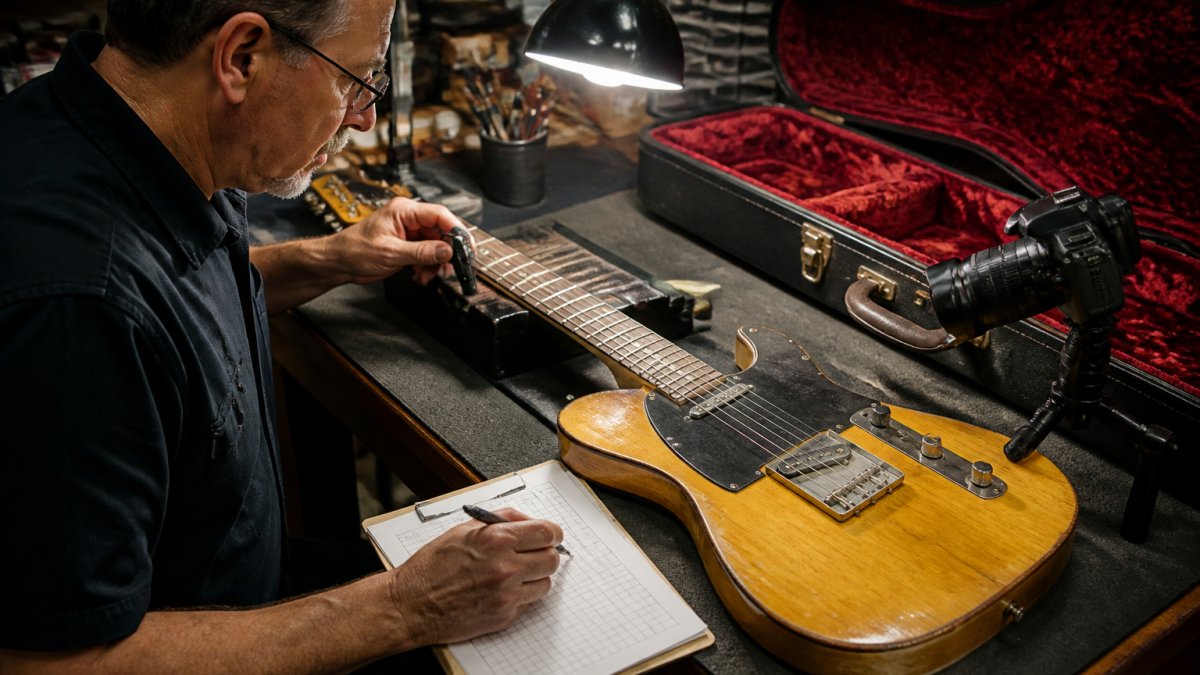
Getting fair trade-in value for instruments requires a systematic appraisal: document what you have, gather the right information, and get quotes from multiple sources.
Documenting Condition, Wear, and Required Repairs
Start by assessing the instrument's actual condition. Be honest. What you see is what retailers will see.
Document these areas:
Body and finish
- Scratches, dings, cracks, or finish wear
- Areas where paint is chipped or missing
- Discoloration or staining
- Structural damage like warping
Frets and neck
- Fret wear or flat spots
- Neck straightness and playability
- Fret sprout or lifting
- Binding condition if applicable
Hardware and electronics
- Tuning machine condition and function
- Bridge integrity and intonation
- Pickups (if electric) and output
- Switches, pots, and jack condition
Playability
- Action height (string clearance from frets)
- Intonation accuracy
- Any buzzing or dead spots
- Comfort and playability issues
Repairs needed will reduce value. A guitar needing a new nut, fret leveling, or electronics work is worth less than one ready to play.
Minor cosmetic wear is expected. Major structural damage, electronics failure, or playability issues are deal-breakers for fair value.
Gathering Specifications and Accessories
Retailers want to know exactly what you're selling. Have ready: brand and model, year of manufacture, serial number, wood type, original color or finish, any modifications, and whether it's left- or right-handed.
Accessories matter. A guitar with the original case is worth more than one without, and original documentation, extra strings, or packaging all add value.
Obtaining Online Valuation Quotes with Photos
Take clear photos before requesting quotes. Good photos show condition accurately and speed up the appraisal process.
Photo guidelines:
- Use natural lighting or bright indoor lighting
- Photograph the front, back, and sides of the body
- Close-up of the headstock and tuning machines
- Close-up of the neck and frets
- Pickups and electronics (if electric)
Submit photos with your appraisal request, including specifications and condition notes. Most retailers provide a preliminary quote within 24-48 hours.
Get quotes from at least three sources. Some retailers specialize in certain brands, some focus on high-end instruments, others buy anything.
Sell or Trade In a Guitar: Weighing Your Options
Getting fair trade-in value for instruments is one path, but not the only one. Understanding your alternatives helps you choose.
Trade-In vs. Private Sale vs. Store Credit
Each option has trade-offs. The right choice depends on your priorities.
Trade-in (quick cash)
- Pros: Fast payment, no hassle, no waiting for a buyer, no shipping risk
- Cons: Lower payout, no negotiation on price, immediate loss of the instrument
- Best for: Musicians who want quick cash and value convenience
Private sale (higher return)
- Pros: Potentially 20-40% more money, you set the price, control the narrative
- Cons: Takes weeks or months, requires photos and descriptions, shipping risks, buyer disputes, time managing inquiries
- Best for: Valuable instruments, rare models, patient sellers
Store credit (convenience)
- Pros: Often higher credit value than cash trade-in, applies to new purchase immediately, simplifies upgrading
- Cons: Locked into one retailer, can't use elsewhere, forces spending you might not plan
- Best for: Musicians already planning to buy from that retailer
Compare the actual numbers. If a retailer offers $600 cash or $750 store credit and you were planning to buy a $1,200 guitar, that credit saves you $450. If you weren't planning to buy anything, it's worthless.
Factoring in Time, Selling Fees, and Hassle
Private sales sound better on paper, but the hidden costs add up.
Time investment
- Writing descriptions
- Taking photos
- Responding to inquiries
- Arranging shipping or local pickup
- Handling returns or disputes
This easily adds 10-20 hours per instrument.
Selling fees
- Platform fees (typically 10-15% on used gear marketplaces)
- Shipping costs (often $30-100 depending on instrument and distance)
- Insurance for shipped items
- Payment processing fees
These reduce net proceeds significantly. An $800 sale might net $650 after fees and shipping.
Risk
- Buyer claims damage during shipping
- Instrument arrives and doesn't match description
- Buyer disputes the transaction
- Instrument sits unsold for months
Trade-in eliminates these risks. You get paid immediately.
The math often favors trade-in more than musicians expect.
How to Negotiate a Guitar Trade-In Offer
A retailer's initial offer is often negotiable, but negotiation requires preparation.
Preparing Your Case with Comparable Sales Data
Go into negotiation with evidence. Show the retailer what similar instruments are selling for.
Gather this data:
- Three comparable instruments sold in the last 30 days
- Condition and specifications matching yours
- Actual selling prices, not asking prices
- Links or screenshots of listings
Present this calmly. Say: "I found three similar guitars selling for $750-850 in the last month. Your offer of $600 seems low.
A fair retailer will acknowledge good data and move closer to market value.
If the retailer won't budge, you can walk away, try another retailer, or pursue a private sale if the time investment makes sense.
Recognizing Red Flags and Unrealistic Offers
Some offers are too good to be true. Others are clearly unfair. Know the difference.
Red flags:
- Offers significantly above market value (bait and switch is coming)
- Retailer won't explain their valuation
- Pressure to decide immediately
- Vague condition assessment ("looks good" without specifics)
- No written offer or terms
Unrealistic low offers:
- Below 40% of fair market value
- No explanation for the gap
- Retailer refuses to discuss it
- Offer doesn't account for condition or rarity
A professional retailer will explain their offer, point to condition issues, market demand, or comparable sales, put it in writing, and answer questions.
Specialty Traders provides written appraisals that explain our reasoning, show comparable sales, detail any repairs needed, and answer questions about how we arrived at the offer.
Key Factors That Determine Trade-In Value
Not all guitars are equal. Some factors matter far more when getting fair trade in value for instruments.
Brand, Model, Year, and Specifications
Brand reputation drives value. A Fender Stratocaster holds value better than an unknown brand.
Model matters too. Certain models are always in demand; others are harder to resell.
Year of manufacture affects value, especially for vintage instruments, a 1959 Les Paul is worth exponentially more than a 2019 model.
Specifications tell the story. Premium woods, quality hardware, and sought-after features add value; basic standard specs are worth less.
Original Parts, Accessories, and Case Inclusion
Original parts increase value. A guitar with all original components is worth more than one with replaced pickups, bridges, or tuners.
The original case is a major factor. A guitar with the original hard case is worth 10-20% more than one with a gig bag or no case.
Modifications can go either way.
The Appraisal Checklist: What Retailers Actually Assess
When you bring an instrument in for appraisal, the retailer checks specific things. Understanding this helps you prepare.
How Retailers Calculate Trade Offers
Retailers use a formula, though they might not explain it:
- Determine fair market value - What similar instruments sold for recently
- Assess condition - Deduct for repairs, wear, or damage
- Calculate retail resale price - What they'll charge when reselling
- Apply margin - Typically 50-70% of retail value becomes the trade-in offer
- Factor in demand - Hot items get higher offers; slow movers get lower ones
- Provide the offer - Usually in writing with explanation
The margin covers their costs and risk. It's business math, not arbitrary.
Margin, Overhead, and Resale Considerations
A retailer buying your guitar at $600 might resell it for $900-1,000.
Factoring in all these costs, a 50-70% trade-in margin is reasonable, not generous, but fair.
Retailers also consider resale speed. A popular model that sells in two weeks justifies a higher offer. A niche instrument that might sit for months justifies a lower one.
Preparing Your Instrument for Appraisal
First impressions matter. A clean, well-maintained instrument gets a better appraisal than a neglected one.
Cleaning, Detailing, and Minor Maintenance
Clean your guitar before appraisal. Dust and grime make condition assessment harder and suggest neglect; a clean instrument appraises better.
What to clean:
- Body and headstock (use appropriate cleaner for the finish)
- Fretboard (use fretboard conditioner if needed)
- Hardware (light polish if tarnished)
- Pickups and electronics (gently remove dust)
- Tuning machines (clean away corrosion)
Don't overdo it, you're removing surface dirt so the real condition is visible, not restoring it.
Minor maintenance helps. New strings and a quick setup improve playability and can shift a trade-in offer higher.
Don't attempt major repairs.
Taking Clear Photos and Gathering Documentation
Photos are your first chance to make a good impression. Clear, well-lit photos speed up appraisal.
Documentation to gather:
- Serial number (photo or written)
- Original receipt or documentation if you have it
- Any warranty information
- Records of repairs or upgrades
- Proof of authenticity for vintage or high-end instruments
Organize this before meeting the retailer.
Getting fair trade-in value for instruments requires knowing what you have, understanding market conditions, and preparing your case.
At Specialty Traders, we've appraised thousands of instruments over 25 years.
Frequently Asked Questions
How do I find out what my used guitar is worth?
Start by identifying your guitar's brand, model, year, and serial number. Check recent comparable sales on online marketplaces and specialized forums to see what similar instruments have sold for recently. Photograph the condition clearly, noting any damage or wear. Request formal valuation quotes from retailers that buy used instruments; most offer free appraisals with photos and specifications. Compare multiple offers to establish a fair market value range.
What affects a musical instrument's trade-in value most?
Condition is the primary driver: damage, fret wear, cracks, and required repairs significantly reduce value. Brand reputation and demand matter greatly, sought-after brands hold value better. Model rarity and age affect desirability; vintage instruments can command premiums if well-maintained. Original parts, accessories, and the included case all add value. Market demand fluctuates, so timing influences offers. Retailers also factor in resale margin and overhead when calculating trade-in offers.
Should I sell my instrument privately or trade it in?
Private sales typically yield higher cash proceeds since you bypass retailer margins, but require more time, effort, and negotiation. Trading in is faster and hassle-free, though you'll receive less cash value, often 50-70% of private-sale price. Store credit may offer a better rate than cash trade-in. Consider your timeline, comfort with negotiation, and whether you're buying from the retailer. For quick upgrades with minimal effort, trade-in wins; for maximum cash recovery, private sale is worth the effort.
How can I negotiate a better trade-in offer?
Gather comparable sales data showing recent prices for identical or very similar instruments to support your valuation. Document condition thoroughly with clear photos and honest descriptions of any damage. Get multiple appraisals to establish a realistic range and show the retailer you've shopped around. Present your case professionally and be prepared to walk away if the offer doesn't meet your research. Retailers sometimes have flexibility, especially on store credit versus cash, so ask about options before accepting an initial offer.