

Last Updated: November 5, 2026
Quick Summary
Inspect used guitar frets by tilting the neck toward a light and sighting down the fretboard edge for flat tops and divots, then run a fingertip along each fret end and slide a thin pick under the strings to catch high frets. Finish with a slow chromatic run up the neck to listen for buzz and dead notes.
- Bring a bright flashlight, a thin pick, a capo, and a clean cloth to the inspection.
- Wear shows first on the first eight frets, especially under the B and high E strings.
- A fret rocker laid across three frets at a time reveals a high fret in the middle.
- Buzz on open strings but not fretted notes usually points to the nut or saddle, not frets.
- Get a written luthier quote on the specific worn frets before you make an offer.
Table of Contents
- The Used Guitar Inspection Checklist: Start With the Frets
- How to Tell If Guitar Frets Are Worn
- A Step-by-Step Fret Inspection Procedure
- The Used Guitar Fret Buzz Test
- How Fret Wear Varies by Playing Position and String
- Guitar Fret Leveling Cost and What It Means for Your Offer
- Shop Inspected Used Guitars at Specialty Traders
- Frequently Asked Questions
The Used Guitar Inspection Checklist: Start With the Frets
Used guitar frets decide whether a used guitar plays in tune or fights you on every chord.
So how do you inspect used guitar frets without a workbench full of tools? You use your eyes, your hands, and a few cheap items.
Fret wear is the most overlooked problem in the used market. Sellers rarely photograph it. Buyers rarely ask about it.
What to Bring to the Inspection
Bring a few small items and you can spot most fret problems in under ten minutes:
- A bright flashlight or your phone light
- A thin guitar pick
- A capo, if you have one
A capo helps you test fret buzz at specific positions. A thin pick slides under the strings to check fret height. The flashlight shows divots and flat spots that vanish in normal light.
If you are prepping for a buy, it also helps to have a replacement set on hand. Our Elixir electric guitar strings two-pack is a practical add-on, since fresh strings make fret wear and dead notes much easier to hear once you get the guitar home.
How to Tell If Guitar Frets Are Worn
Worn frets show up as flat tops, dents, and deep grooves under the strings. A healthy fret has a rounded crown. A worn one looks filed down, usually right where the strings sit most.
Here is how to spot the difference:
- Flat tops: The crown looks shaved or squared off.
- Divots: Small dents or grooves under each string, most common on the first eight frets.
- Uneven shine: Bright, polished patches where strings rub, dull metal elsewhere.
A common mistake is judging wear from a photo. Light and angle hide divots. You need to tilt the neck toward a light source and look down the fretboard edge.
Cleaning as you go helps you see the metal clearly. A tool like the Tonegear string cleaner two-pack lifts grime off strings and the fretboard, which makes flat spots and dents far easier to spot during the inspection.
A Step-by-Step Fret Inspection Procedure
Follow these steps in order. Each one takes a minute or two and builds on the last. Write your findings down as you go, because a used guitar inspection is easier to negotiate when you can point to specific frets.
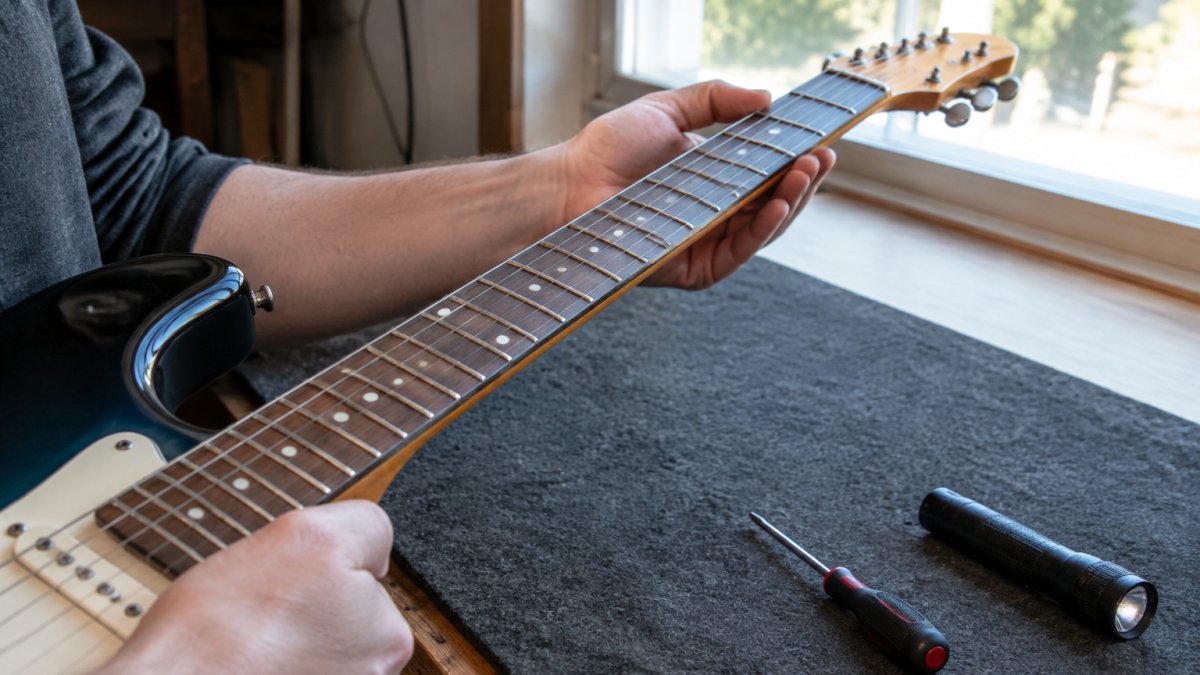
- Tilt and sight down the neck. Hold the guitar toward a window or lamp. Look along the fretboard edge from the headstock. You are checking for a straight neck and level fret tops. A neck with too much relief bows away from the strings in the middle; a back-bowed neck humps up around the middle frets.
- Check each fret for flat spots and divots. Work from the first fret to the last. Pay extra attention under the B and high E strings. Note the fret number and string for every divot you see.
- Run a fingertip along each fret end. Feel for sharp edges or frets that stick out past the board. Run your finger along both sides of the neck, not just the treble side.
- Slide a thin pick under the strings. Rock it gently over each fret. A fret that sits high will catch the pick. This is a rough version of the fret rocker test described below.
- Press each string at the third fret and tap the string over the first fret. A click means the nut slot is too high or the fret is low. Repeat at the third and fifth frets to check the middle of the neck.
- Play a slow chromatic run up the neck. Listen for buzz, dead notes, and choked bends. Play each string separately so you can tell which string path has the problem.
- Record your findings. Write down the fret numbers with divots, the frets that buzz, and any sharp ends. A simple list like "divots at frets 2-5 under B and high E; buzz at fret 7 on G string" is enough to guide a repair estimate or a negotiation.
If you are coming from a guitar with a worn, flattened fretboard, expect the first eight frets to feel noticeably different on a well-kept instrument.
Checking Fret Level With Simple Tools
A visual pass finds divots, but it does not prove the frets are level. Three inexpensive tools make the check repeatable.
- A fret rocker. This is a short metal bar with three or four straight edges of different lengths. Lay it across three frets at a time and rock it. If it rocks, the middle fret is high. Move it up and down the neck on each string path. A fret rocker costs less than a set of strings and is the single most useful tool for this job.
- A straightedge. A short machined straightedge laid along the fret tops shows whether the neck has a consistent fall-away or a hump. Hold it against the light; gaps show where the fret plane is not straight.
- A feeler gauge. Once you find a high fret with the rocker, a feeler gauge tells you how high. Slide the thinnest blade that fits under the rocker at the high spot. A gap of a few thousandths of an inch is a minor leveling job; a larger gap points to a lifted or poorly seated fret.
Watch out: a fret rocker will flag a high fret even when the real problem is a low fret next to it. Rock the tool across several groups of three frets so you can tell which fret is actually out of plane.
Checking Fret Ends and Fret Protrusion
Sharp fret ends are a seasonal problem. Dry air shrinks the fretboard, and the metal frets stay put, so their ends poke out. Run your hand along both edges of the neck. If the ends feel like tiny blades, the guitar needs fret end dressing.
This is usually a minor fix, but it signals how the guitar has been stored. A dry, neglected fretboard often comes with other setup issues.
The Used Guitar Fret Buzz Test
Fret buzz is the fastest way to find a problem fret. Play every string at every fret, one note at a time.
Buzz can come from three places:
ESP LTD KH-602 Kirk Hammett Purple Sparkle EMG Guitar & Case KH602PSP #1773 Used →
- A high or lifted fret that catches the string
- Too-low action at the bridge or nut
- Too little neck relief, so the strings sit close to the frets
A capo makes this easier. Our Paige Clik capo is a simple way to isolate buzz at specific positions during a test.
Watch out: buzz on open strings but not fretted notes usually means a nut or saddle issue, not worn frets.
How Fret Wear Varies by Playing Position and String
Fret wear is not spread evenly. It follows the player.
Most players spend their time in the lower frets, so the first eight frets wear first. The unwound strings, especially the B and high E, cut deeper grooves because they are thin and press hard into the metal. The low E and A strings wear more slowly.
Here is the pattern to expect:
| Playing Position | Typical Wear | What It Tells You |
|---|---|---|
| Frets 1-5 | Heavy divots under B and high E | Player spent most time on open chords |
| Frets 5-8 | Moderate flat spots | Regular rhythm and lead work |
| Frets 9-12 | Light wear | Occasional upper-register playing |
| Frets 12+ | Minimal wear | Guitar saw mostly chord work |
Bends wear frets sideways too. A player who bends a lot leaves grooves that run across the fret, not just under the string. Check for those on the upper frets where lead players spend their time.
Guitar Fret Leveling Cost and What It Means for Your Offer
Fret work is not cheap, and that changes what a used guitar is worth to you.
- Cosmetic wear. Shallow polish marks and light flat spots with no buzz and no dead notes. No repair needed. This is normal for any played guitar.
- Fret dress and recrown. Moderate divots with minor buzz or tuning instability. A tech levels the tops, recrowns them, and polishes. This is the most common fret repair and is usually quoted as a single bench fee plus setup.
- Level and recrown with a partial refret. Deep divots, a few lifted frets, or wear concentrated in the first five frets. The tech replaces the worst frets and levels the rest. Cost depends on how many frets are replaced.
A fret end dressing for sharp ends is usually the cheapest fix and is often bundled with a setup. Costs vary widely by instrument, fretboard material, fret wire type, and local labor rates, so ask for a written estimate rather than relying on a rule of thumb.
How to Use a Luthier Estimate in Negotiation
Get the estimate before you make an offer, not after.
A practical approach:
- Inspect the frets using the procedure above and note the specific frets with divots or buzz.
- Ask a local tech for a quote on those specific frets, not a vague "fret work" estimate.
- Subtract the quote from the asking price, then add a small buffer for setup and strings.
- Present the findings and the quote to the seller. Sellers respond better to "frets 2-5 have divots and the tech quoted a dress and recrown" than to "the frets look worn."
Watch out: do not use a refret quote to negotiate a guitar that only needs a dress.
Ask the seller for the fret history. If the guitar has never been leveled and shows deep divots, factor that into your offer. A guitar that needs fret work is not a bad buy.
Shop Inspected Used Guitars at Specialty Traders
Every instrument we sell undergoes a thorough inspection and setup before it ships. You get a guitar that has been checked for proper functionality before it reaches you.
Here is a real example from our current stock: the ESP LTD KH-602 Kirk Hammett Purple Sparkle at $999.00.

If you want to practice the fret inspection yourself, start with the Fret King JDD Jerry Donahue T Style.
Frequently Asked Questions
How much fret wear is acceptable on a used guitar?
Light, even wear across the first eight frets is normal on any played guitar and usually does not affect playability. Acceptable wear means shallow indentations you can feel but not catch a fingernail in, with no dead notes or buzz. Repair-level wear means deep divots under the unwound strings, flat-topped frets, or buzzing that persists after a setup. If you can feel a groove deep enough to trap a fingernail, budget for a fret dress or refret in your offer.
How do you check for high or uneven frets on a used guitar?
Use a short straightedge or a fret rocker across three frets at a time along the fretboard. If the tool rocks back and forth, the middle fret sits high. Repeat this up and down every string path. Then play a chromatic scale on each string from the first fret to the highest fret and listen for buzz or dead notes that appear at the same fret position across multiple strings. A high fret shows up as a buzz on the next fret up from the problem.
Can worn frets affect a used guitar's value?
Yes. Deep divots, flat frets, or sharp fret ends lower resale value because the buyer inherits the repair bill. Get a written repair estimate from a local tech and use that figure to negotiate: a guitar with repair-level fret wear should be priced below a clean example by at least the cost of the fix.
What is the used guitar fret buzz test and how do I run it?
The used guitar fret buzz test checks whether buzz comes from fret problems or from setup issues like action and neck relief. Play each open string, then fretted notes up the neck, then chords and bends. Buzz on open strings only points to the nut or neck relief. Buzz at the same fret on multiple strings points to a high or uneven fret. Buzz that appears only when you dig in hard is usually action, not frets. Ask the seller whether the guitar has had a recent setup before you blame the frets.
Fret wear is the detail that separates a smart used-gear buy from a costly mistake. At Specialty Traders, we check every fret, every neck, and every setup before an instrument leaves our shop, backed by more than 25 years in the music retail business and free US shipping on most items. Browse our inspected used guitars and buy with confidence.
