

Table of Contents
- What Makes Equipment Reliable for Instrument Repair
- Quality Assurance and Inspection Protocols
- Professional Guitar Setup Tools and Component-Level Repair Standards
- Best Practices for Tool Calibration and Accuracy Verification
- Preventative Maintenance and Instrument Longevity
- Vetting Repair Facilities: What to Look For
- Equipment Lifecycle Cost Analysis
- Conclusion
- Frequently Asked Questions
Last Updated: October 4, 2026
What Makes Equipment Reliable for Instrument Repair
When you're shopping for inspected equipment instrument repair gear for guitars or basses, reliability isn't a luxury, it's the foundation of your entire operation. At Specialty Traders, we understand that choosing the right tools is important. Equipment that functions properly means fewer failed repairs, faster turnarounds, and customers who trust your work.
Reliable equipment starts with rigorous inspection protocols. Before any tool leaves a repair bench, it needs to prove itself through functionality testing and precision calibration. This isn't about having the newest gear, it's about having tools that deliver consistent results every single time you use them.
The real challenge most repair techs face isn't finding tools. It's finding inspected equipment instrument repair that has been properly tested and calibrated before it arrives. Many shops buy used equipment without knowing its history, only to discover hidden wear or calibration drift months into service. That's where proper vetting becomes critical.
Quality Assurance and Inspection Protocols
Comprehensive quality assurance means more than a visual once-over. Professional repair facilities implement multi-stage inspection routines that check every critical component and operational parameter. This is what separates inspected equipment from untested gear.
A solid quality assurance process includes:
- Visual assessment of all external components for damage, corrosion, or wear
- Functional testing under load to verify performance specifications
- Component-level inspection of internal parts, springs, and mechanical assemblies
- Documentation of all findings and any refurbishment work performed
When you source equipment through providers who follow these protocols, you're getting tools with a verified service history. Specialty Traders ensures every instrument undergoes thorough inspection and setup for proper functionality before it ships. This means you're not inheriting someone else's problems.
The key is transparency. Any reputable supplier should document their inspection process and share results with you. If they won't tell you what they checked or how they tested it, that's a red flag. Professional-grade equipment comes with a paper trail that proves its reliability.
Professional Guitar Setup Tools and Component-Level Repair Standards
The tools you choose directly impact the quality of your repairs. Component-level repair work requires precision instruments that maintain accuracy across hundreds of hours of use. This is where equipment selection becomes non-negotiable.
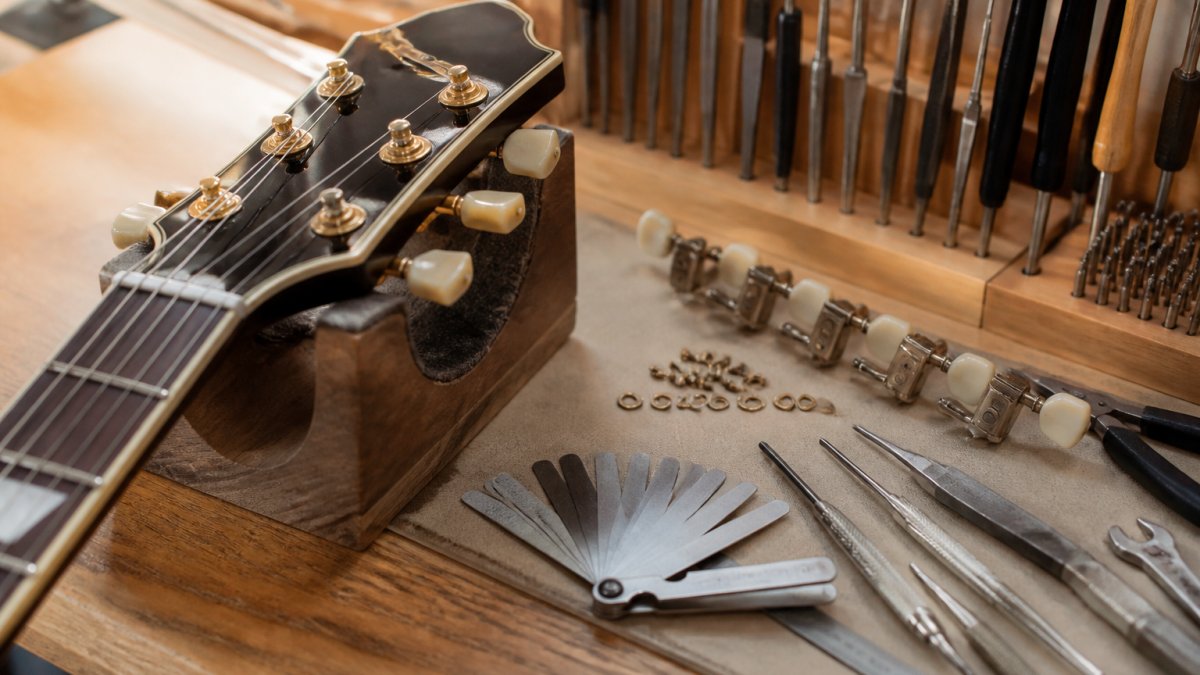
Hand Tools for Precision Work
Hand tools form the backbone of guitar repair. Fret crowning files, straightedges, radius gauges, and truss rod wrenches must maintain their tolerances indefinitely. A file that dulls or a gauge that loses calibration will throw off every measurement you make.
The best hand tools share common characteristics: they're made from hardened steel, they're precision-ground to exact specifications, and they've been tested under actual working conditions. When you're evaluating hand tools, look for:
- Hardened steel construction that resists wear
- Precision grinding that maintains edge sharpness
- Ergonomic design that reduces fatigue during extended use
- Documented calibration records from the manufacturer
Many shops make the mistake of buying budget tools and replacing them frequently. Professional-grade hand tools cost more upfront but deliver better results and last longer. The math favors quality every time.
Power Tools and Diagnostic Equipment
Power tools accelerate work but introduce new reliability concerns. A power drill that loses torque consistency or a rotary tool with bearing play compromises precision. Diagnostic equipment like multimeters and oscilloscopes must hold calibration to catch electrical issues reliably.
For power tools, reliability depends on:
- Consistent motor speed and torque under load
- Bearing integrity that eliminates runout or wobble
- Electrical safety features that prevent damage to instruments
- Regular maintenance access for bearing and brush replacement
Diagnostic equipment requires even stricter standards. A multimeter that drifts 2% over six months will miss subtle wiring problems. Oscilloscopes need calibration verification every 12 months to catch intermittent faults. These tools directly impact your ability to diagnose and fix electrical issues correctly.
The equipment you choose should come with calibration certificates and maintenance schedules. If a supplier can't provide that documentation, the equipment isn't professional-grade.
Best Practices for Tool Calibration and Accuracy Verification
Calibration isn't a one-time event, it's an ongoing commitment to maintaining the reliability metrics that define professional-grade work. Tools drift out of spec through normal use, temperature changes, and mechanical wear. Understanding how much drift matters, and when it becomes a failure risk, separates shops that catch problems from shops that ship defective repairs.
Understanding Calibration Drift and Reliability Metrics
Most repair professionals think about calibration in binary terms: in spec or out of spec. The reality is more nuanced. A straightedge that's 0.002 inches off might be acceptable for rough work but unacceptable for precision fret leveling. A feeler gauge that's drifted 5% might still catch gross action problems but miss the subtle clearance issues that cause buzzing.
The key metric is acceptable tolerance drift, the maximum deviation from original specification before the tool becomes unreliable for its intended use. For guitar repair work:
- Fret straightedges: Drift tolerance of ±0.001 inches over the length of the neck. Beyond this, fret leveling becomes inaccurate and creates playability problems.
- Radius gauges: Drift tolerance of ±0.005 inches. A 10-inch radius gauge that drifts to 10.010 inches will misidentify fret crowning problems.
- Feeler gauges: Drift tolerance of ±0.001 inches per blade. A 0.010-inch feeler that's actually 0.011 inches will misread action clearances by 10%.
- Multimeters and continuity testers: Drift tolerance of ±2% of full scale. A meter reading 9.8V on a 10V circuit is acceptable; one reading 9.5V might miss a failing power supply.
- Torque wrenches: Drift tolerance of ±4% of the set value. A wrench set to 50 inch-pounds that's actually delivering 52 inch-pounds will over-tighten tuning machines and bridge pins.
These tolerances matter because they directly impact your repair success rate. A shop using straightedges that have drifted 0.003 inches will produce frets that buzz or rattle. Customers will return instruments. Your reputation suffers. The cost of recalibration, typically $15-$40 per tool, is trivial compared to the cost of one failed repair and a customer complaint.
Establishing a Calibration Schedule Based on Usage Intensity
Not all tools need the same calibration frequency. A straightedge used daily needs more frequent verification than one used monthly. A power drill used for eight hours a day will drift faster than one used for two hours a week.
Use this framework to set your calibration schedule:
| Tool Type | Daily Use (8+ hrs) | Moderate Use (2-4 hrs) | Light Use (<2 hrs) | Verification Method |
|---|---|---|---|---|
| Straightedges and radius gauges | Every 3 months | Every 6 months | Every 12 months | Master gauge comparison or precision straightedge check |
| Feeler gauges | Every 6 months | Every 12 months | Every 18 months | Precision gauge block set or caliper verification |
| Multimeters and testers | Every 6 months | Every 12 months | Every 18 months | Certified calibration service or known-good reference standard |
| Fret crowning files | Every 2 months | Every 4 months | Every 6 months | Straightedge verification under load |
| Truss rod wrenches | Every 12 months | Every 18 months | Every 24 months | Torque wrench check or certified calibration service |
| Power drills and rotary tools | Every 6 months | Every 12 months | Every 18 months | Runout check with dial indicator; bearing inspection |
The key is matching calibration frequency to actual usage. A shop that does five setups a day will use straightedges and radius gauges more intensively than a shop that does two. Adjust your schedule accordingly.
Documenting Calibration and Creating an Audit Trail
Professional-grade equipment maintenance requires documentation. Keep a calibration log for every tool in your shop that records:
- Tool name and serial number (if applicable)
- Calibration date and method (which reference standard or service was used)
- Results (was the tool in spec? By how much did it drift?)
- Any adjustments made (if the tool was adjusted back to spec, document the adjustment)
- Next calibration due date
This log serves three purposes. First, it prevents you from using uncalibrated tools by accident, you know at a glance which tools are due for verification. Second, it creates accountability. If a customer disputes a repair, you can prove your equipment was accurate when you performed the work. Third, it identifies patterns. If a particular tool drifts consistently, you might replace it rather than continuing to recalibrate.
Many shops use a simple spreadsheet; others use dedicated tool-tracking software. The format matters less than consistency. Update the log after every calibration event.
Choosing Calibration Services and Reference Standards
For hand tools like straightedges and gauges, you can often verify calibration in-house using precision reference standards, master gauges, gauge block sets, or certified straightedges. This is fast and inexpensive.
For electronic equipment like multimeters, oscilloscopes, and torque wrenches, professional calibration services are often necessary. These services use certified reference standards traceable to the National Institute of Standards and Technology (NIST) and provide documentation that proves your equipment meets specification. Expect to pay $25-$75 per tool for annual calibration.
When selecting a calibration service, verify they provide NIST-traceable certificates. This documentation is critical if you ever need to defend the accuracy of your work. A certificate that simply says "in spec" is less valuable than one that documents the actual measured values and the reference standards used.
Some equipment manufacturers offer calibration services or can recommend certified providers. Take advantage of these resources. They understand the specific tolerances and procedures your equipment requires.
Preventative Maintenance and Instrument Longevity
Equipment that's properly maintained lasts longer and performs more reliably. Preventative maintenance catches small problems before they become expensive failures. A guitar that receives regular maintenance stays playable for decades. One that's neglected degrades quickly.
Develop maintenance routines for each category of equipment:
- Hand tools: Clean after each use, store in dry conditions, inspect for damage or wear
- Power tools: Check bearings and brushes monthly, replace worn components before failure, keep air vents clear
- Diagnostic equipment: Store in temperature-controlled environments, verify calibration before critical work, replace batteries regularly
- Tuning machines and hardware: Lubricate moving parts annually, inspect for corrosion, verify functionality under load
The goal is preventing wear and tear from accelerating. A tool that's properly maintained maintains its accuracy and reliability. One that's neglected becomes unreliable and eventually unusable.
Many shops also benefit from upgrading components before they fail. If a power tool's bearings are showing early signs of wear, replacing them now prevents sudden failure during a critical repair. This proactive approach keeps your shop running smoothly.
Specialty Traders understands that equipment longevity depends on both initial quality and ongoing care. That's why we ensure every instrument we ship has been properly inspected and set up, it's the foundation for long-term reliability. Consistent maintenance protocols ultimately determine the lifespan of these tools, a reality reflected in our comprehensive instrument warranty reviews.
Vetting Repair Facilities: What to Look For
Not all repair shops follow the same standards. When you're choosing where to send instruments or where to source equipment, knowing what to evaluate matters. A facility that prioritizes quality assurance will have systems and documentation to prove it.
Evaluate repair facilities based on these criteria:
Inspection and Testing Protocols Ask about their quality assurance process. Do they document every inspection? Can they show you their testing procedures? Professional facilities maintain detailed records and can walk you through their methodology.
True Lok TK-7111-002 Vintage Style Locking Tuners 3x3 Gold →
Equipment and Tooling Tour their workspace if possible. Look for organized, well-maintained equipment. Are their tools calibrated? Do they have diagnostic equipment for testing? A professional shop invests in the right tools and maintains them properly.
Technical Proficiency and Credentials Ask about certifications or training. Have their technicians completed formal apprenticeships? Do they stay current with industry standards? Experience matters, but documented training demonstrates commitment to technical excellence.
Compliance and Documentation Professional facilities maintain detailed records of every repair. They document the condition before work, the work performed, and the condition after. This creates accountability and protects both the shop and the customer.
Component-Level Repair Capability Can they repair individual components, or do they only replace whole assemblies? True professionals understand how to diagnose and repair at the component level. This saves customers money and demonstrates technical depth.
When vetting a facility, ask for references from other musicians or shops. Ask to see examples of their work. A professional facility is proud of their standards and happy to demonstrate them.
Equipment Lifecycle Cost Analysis
The cheapest equipment rarely delivers the best value. Understanding total cost of ownership, the sum of purchase price, maintenance, calibration, replacement, and downtime costs over the tool's usable life, is the framework that separates shops making smart investments from shops that waste money on budget gear.
The True Cost of Budget Equipment vs. Professional-Grade Tools
Consider a concrete example: a straightedge for fret leveling. A budget straightedge costs $30-$50. A professional-grade straightedge costs $120-$200. On the surface, the budget option seems like the obvious choice. But the lifecycle cost tells a different story.
Budget straightedge scenario:
- Initial cost: $45
- Usable lifespan: 18-24 months of daily use (approximately 400-500 hours)
- Calibration drift: Begins drifting noticeably after 6 months; by 12 months, drift exceeds acceptable tolerance
- Calibration cost: $20 per verification (but the tool is often too worn to recalibrate accurately)
- Replacement frequency: Every 18-24 months
- 5-year total cost: $45 × 3 replacements = $135 in equipment alone, plus $40-$60 in calibration attempts
- 5-year total: approximately $175-$195
- Hidden cost: Inaccurate frets on repairs performed during months 6-18 of each tool's life, leading to customer callbacks and reputation damage
Professional-grade straightedge scenario:
- Initial cost: $160
- Usable lifespan: 5-7 years of daily use (approximately 2,000-2,500 hours)
- Calibration drift: Minimal drift for first 3 years; stays within acceptable tolerance with proper maintenance
- Calibration cost: $25 per annual verification (typically only confirms the tool is still in spec)
- Maintenance cost: Occasional cleaning and storage care; no parts replacement needed
- Replacement frequency: Once every 5-7 years
- 5-year total cost: $160 initial + ($25 × 5 annual calibrations) = $285
- 5-year total: approximately $285
- Hidden benefit: Accurate frets on every repair, zero callbacks due to leveling errors, consistent customer satisfaction
Over five years, the professional-grade straightedge costs only $90 more but delivers 5× the usable hours, maintains accuracy throughout its life, and eliminates the hidden cost of failed repairs. The math is clear: professional-grade equipment wins on total cost of ownership.
Building a Lifecycle Cost Model for Your Shop
Apply this analysis to every category of equipment. Calculate lifecycle cost using this formula:
Total 5-Year Cost = (Purchase Price) + (Annual Calibration Cost × 5) + (Replacement Cost × Number of Replacements) + (Estimated Downtime Cost)
Downtime cost is the hardest variable to quantify but often the most significant. If a power tool fails during a critical repair and you lose four hours of billable work, that's a real cost. If a multimeter fails and you misdiagnose an electrical problem, leading to a customer callback, that's a real cost. Budget conservatively for downtime.
Example: Power drill for guitar body work
-
Budget power drill: $35 purchase, 2-year lifespan, 1 replacement needed in 5 years = $70 equipment cost
- Plus: 2 hours of downtime when the first drill fails during a body routing job = $100 in lost billable time (assuming $50/hour shop rate)
- Plus: Potential rework cost if the drill's inconsistent torque caused damage = $50-$150
- 5-year total: $220-$320
-
Professional-grade power drill: $120 purchase, 5-year lifespan, 0 replacements needed
- Plus: Annual maintenance (bearing inspection, brush replacement) = $15 × 5 = $75
- Plus: Zero downtime failures
- 5-year total: $195
Again, the professional tool is cheaper over five years and eliminates the risk of failure-related downtime.
Identifying High-Impact Equipment for Lifecycle Analysis
Not all tools deserve the same analysis depth. Prioritize lifecycle cost evaluation for:
-
Tools used daily (straightedges, radius gauges, power drills, multimeters). These accumulate hours quickly and have the highest impact on your repair quality and shop efficiency.
-
Tools that directly affect repair quality (fret crowning files, feeler gauges, tuning machines, diagnostic equipment). A failure here means failed repairs and customer callbacks, the most expensive outcome.
-
Tools with high replacement frequency (files, brushes, bearings, drill bits). If you're replacing a tool every 18 months, the cumulative cost is significant.
-
Tools with high downtime cost (power tools, diagnostic equipment). If a tool fails and you can't complete a repair, the lost revenue is substantial.
Tools with low daily usage (specialty files, uncommon gauges, backup equipment) can often be budget options. The lifecycle cost is low because they're used infrequently.
Making the Business Case for Equipment Investment
When you calculate lifecycle cost, you're not just comparing prices, you're comparing outcomes. Professional-grade equipment delivers:
- Fewer failed repairs (better accuracy = fewer callbacks)
- Faster repair turnaround (reliable tools don't fail mid-job)
- Higher customer satisfaction (consistent, accurate work)
- Lower total cost of ownership (longer lifespan, less frequent replacement)
- Better shop reputation (reliability compounds over time)
Shops that perform this analysis consistently choose higher-quality equipment. They understand that reliability isn't an expense; it's an investment in their operation's profitability and reputation.
Conclusion
Reliable, inspected equipment that functions properly is the foundation of expert instrument repair. It starts with rigorous quality assurance protocols, continues through precision calibration and verification, and depends on consistent preventative maintenance. When you prioritize equipment reliability, you protect your reputation and deliver better results for your customers.
The shops that succeed aren't always the ones with the newest gear, they're the ones with equipment that's been properly selected, inspected, and maintained. They understand that reliability compounds over time. Every repair that goes right builds customer trust. Every failure erodes it.
At Specialty Traders, we've spent over 25 years sourcing and preparing instruments and equipment that meet professional standards. Every guitar, bass, and component we ship has undergone thorough inspection and setup for proper functionality. We offer free US shipping on most items and stand behind our quality.
Shop Now and experience the difference that properly inspected, reliable equipment makes in your repair work.
Frequently Asked Questions
How do I know if instrument repair equipment has been properly inspected?
Reliable inspected equipment comes from facilities that document quality assurance protocols. Look for vendors who perform rigorous inspection of each component, verify functionality testing results, and provide technical documentation. Professional repair facilities maintain compliance records and can describe their inspection process in detail. Ask about specific tests performed on tuning machines, diagnostic tools, and hand instruments before purchase or repair work begins.
What are the best practices for tool calibration in instrument repair?
Professional tool calibration requires regular verification against known standards. Precision instruments used in guitar setup, such as straightedges, feeler gauges, and tension measurement tools, should be checked quarterly or before critical repairs. Calibration involves comparing tool readings against certified references and documenting results. Many repair facilities use calibrated reference guitars or precision blocks to verify accuracy. Maintaining calibration logs ensures device integrity and prevents wear-and-tear from affecting measurement reliability.
Why is preventative maintenance important for instrument repair equipment?
Preventative maintenance extends equipment longevity and maintains operational efficiency. Regular cleaning, lubrication of moving parts, and inspection for defective components prevent costly downtime and inaccurate repairs. Luthiers who follow preventative maintenance schedules catch wear and tear early, replacing tension washers, worm gears, or string posts before they compromise performance. Scheduled maintenance also validates that tools meet performance standards, ensuring every repair meets technical specifications and maintains instrument integrity.
What should I look for when choosing a repair facility with reliable equipment?
Evaluate repair facilities by asking about their quality assurance protocols, technical proficiency of staff, and equipment maintenance schedules. Request information on their inspection procedures, calibration practices, and compliance with industry standards. Professional facilities should provide evidence of rigorous testing on instruments before and after repair. Ask about their diagnostic testing methods, re-assembly procedures, and technical documentation practices. Facilities with transparency about their equipment and processes demonstrate commitment to device integrity and sound restoration.
Guitar repair standards and best practices from industry professionals
Precision tool calibration requirements and verification methods
Professional equipment maintenance guidelines for musical instrument repair