

Table of Contents
- What Does Professional Guitar Setup Include
- Truss Rod Adjustment and Neck Relief
- Setting String Action Height
- Nut Slot Depth and Adjustment
- Intonation Calibration and Bridge Setup
- How Much Does a Guitar Setup Cost
- How Long Does a Guitar Setup Take
- Signs Your Guitar Needs a Setup
- Frequently Asked Questions
Last Updated: September 27, 2026
What Does Professional Guitar Setup Include
A professional guitar setup is a comprehensive adjustment and calibration of your instrument to optimize playability, tone, and tuning stability. At Specialty Traders, every instrument undergoes thorough inspection and setup before shipping.
A professional setup adjusts multiple components working together to make your guitar easier to play while protecting its long-term condition. Each part affects the others, and skipping one step creates problems elsewhere.
Here's what a complete setup covers:
- Truss rod adjustment for proper neck relief
- String action height calibration
- Nut slot depth and width optimization
- Intonation measurement and bridge saddle adjustment
- Pickup height adjustment for tone balance
- Hardware inspection and tightening
- Complete cleaning and conditioning
A professional setup fixes multiple playability issues at once: high action, buzzing frets, and poor intonation.

Truss Rod Adjustment and Neck Relief
The truss rod controls your guitar neck's bow and is the foundation of any professional guitar setup. This single adjustment affects everything else, and it's where many DIY attempts go wrong.
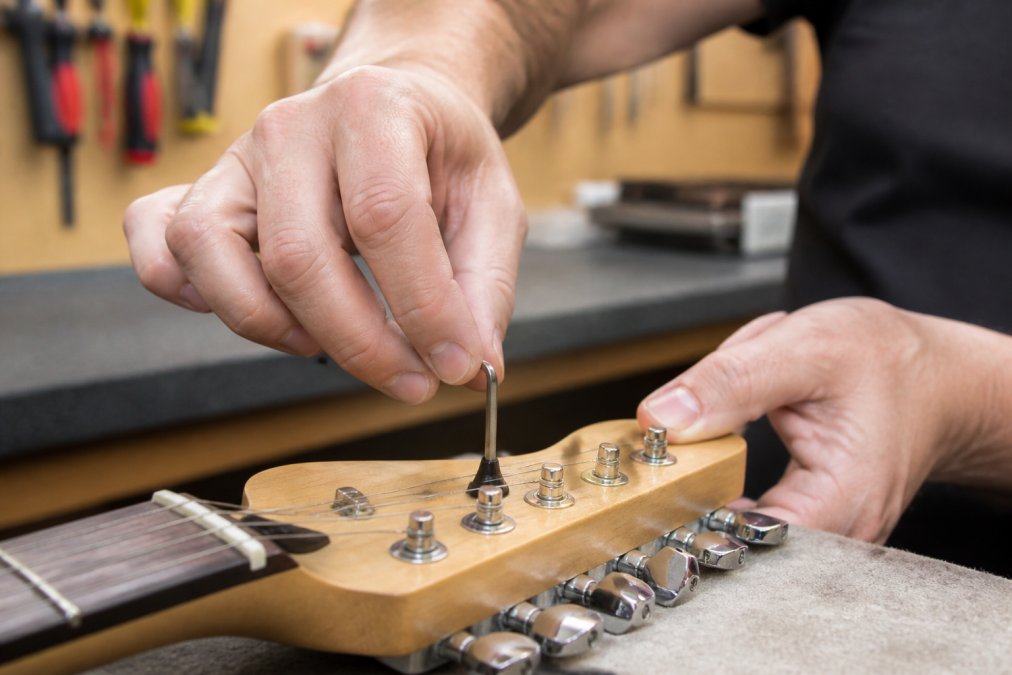
Your guitar neck naturally bows forward under string tension. A small amount of forward bow (relief) prevents frets from buzzing when you play hard. Too much relief makes action too high; no relief causes frets to buzz everywhere.
A technician measures neck relief using a straightedge placed along the frets, checking the gap at the middle of the neck.
Why This Requires Professional Expertise
The truss rod adjustment is where DIY becomes dangerous.
What a Professional Actually Does
A technician measures current relief, applies steady controlled pressure with the correct tool, then re-measures to confirm the adjustment.
Signs your neck needs adjustment:
- Frets buzz when you play open strings hard
- Action is too high even after saddle adjustment
- The neck looks visibly bowed or back-bowed
- Some frets buzz while others don't
- You've recently changed string gauge or tuning
Setting String Action Height
String action is the distance between your strings and the fretboard. Lower action feels easier but risks fret buzz; higher action requires more finger pressure but gives cleaner tone.
A professional setup measures action at the 12th fret (middle of the neck). A tech adjusts the bridge saddle to achieve your target height.
The bridge saddle holds strings at the correct height. On electric guitars with adjustable bridges, you turn screws or loosen clamps.
Nut Slot Depth and Adjustment
The nut is the small piece at the headstock where strings sit before reaching the tuning pegs. Nut slot depth dramatically affects open-string playability and tone. Shallow slots cause buzzing; deep slots make open strings sit too high.
Proper nut slot depth prevents buzzing while keeping action low.
A professional tech carefully deepens each slot while checking clearance.
Signs your nut needs adjustment:
- Open strings buzz against the first fret
- Open strings sit noticeably higher than fretted notes
- The nut is cracked or visibly worn
- Tuning stability suffers on open strings
Intonation Calibration and Bridge Setup
Intonation means your guitar plays in tune across the entire fretboard. A guitar can be perfectly tuned at the headstock but out of tune higher up the neck if the bridge saddle is positioned incorrectly.
The bridge saddle's distance from the nut determines intonation.
A professional uses a tuner to check intonation at multiple frets.

On electric guitars, small saddle screws or bridge pieces move back and forth.
How Much Does a Guitar Setup Cost
Professional guitar setup pricing varies based on what work your instrument needs. A basic setup typically runs between $50 and $150. This covers truss rod adjustment, action setup, and intonation.
Leo Quan Badass V 5 String Bass Bridge →
At Specialty Traders, we include professional setup with most of our instruments at no extra charge. When you buy from us, your guitar arrives ready to play. We handle the technical work so you don't have to.
How Long Does a Guitar Setup Take
A basic professional guitar setup takes 2-4 hours of actual work time. However, turnaround time at a shop is usually 1-2 weeks because techs work on multiple instruments.
Breaking down the timeline:
- Neck relief check and truss rod adjustment: 30 minutes
- Action and bridge setup: 45 minutes
- Nut slot adjustment: 30 minutes
- Intonation calibration: 30 minutes
- Final inspection and cleanup: 15 minutes
When you order from Specialty Traders, we complete setup before shipping. This means your instrument arrives fully adjusted and ready to play immediately. You skip the waiting period entirely.
Signs Your Guitar Needs a Setup
Even new guitars benefit from professional setup. Here's what to watch for:
Before You Book a Setup
Your guitar buzzes when you play. Fret buzz usually means either insufficient neck relief or action set too low. A quick setup fixes this.
Playing feels harder than it should. If your fingers hurt after short practice sessions, action is probably too high. A setup reduces action to a comfortable level.
Tuning won't stay stable. If you tune and the guitar goes flat within minutes, the nut may need adjustment or the bridge saddle may be loose. A setup includes checking these components.
Open strings sound muted or dull. A loose nut or improperly fitted bridge saddle dampens string vibration. Setup tightens these connections.
The neck looks visibly bowed or twisted. This indicates truss rod adjustment is needed. Don't ignore visible neck problems.
Intonation drifts as you play up the neck. If the 12th fret plays noticeably sharp or flat, bridge saddle position needs adjustment.
Your guitar was stored in a different climate for months. Wood expands and contracts with humidity changes. Setup compensates for seasonal movement.
After You Pick Up Your Setup: Verification Checklist
A professional setup is only valuable if it was actually completed. Use this checklist to verify the work before you leave the shop or after receiving your guitar:
Playability Tests
- Fret buzz test: Play each string open, then fretted at the 1st, 5th, 12th, and last fret. No buzzing should occur on any string at any fret, even when playing hard.
- Action measurement: Measure string height at the 12th fret with a ruler or action gauge. Bass side should be around 2.0mm (electric) or 2.5mm (acoustic). Treble side should be around 1.5mm (electric) or 2.0mm (acoustic). Ask the tech what they set it to, it should match your playing style preference.
- Neck relief check: Ask the tech to show you the neck relief measurement. It should be 0.010 inches or less. They should have documented this.
Intonation Verification
- 12th fret tuning: Tune the open string, then play the 12th fret harmonic and the fretted 12th fret note. All three should read the same on a tuner. Check all six strings.
- Upper fret accuracy: Play fretted notes at the 15th and 19th frets on each string. They should be in tune relative to the open string tuning.
- Consistency across strings: Intonation should not drift noticeably as you move from the bass strings to the treble strings.
Hardware and Fit
- Nut slots: Open strings should sit slightly higher than the first fret (about 0.5mm clearance). No buzzing on open strings, but open strings shouldn't feel dramatically higher than fretted notes.
- Bridge saddle: On electric guitars, the saddle should be secure and not rocking.
- Tuning stability: Tune the guitar, bend strings, and re-tune. The guitar should return to pitch quickly. Tune again after 10 minutes, it should hold tune.
- Hardware tightness: Gently try to move the bridge (on acoustics), tuning machines, and strap buttons. Nothing should rattle or move.
Visual Inspection
- Neck alignment: Sight down the neck from the headstock. The neck should be straight or have very slight relief, no visible back-bow or excessive forward bow.
- Fret condition: Look at the frets under bright light. They should be shiny and level, not dull or worn in spots (unless fret leveling wasn't part of the setup).
- Cleanliness: The fretboard should be clean, and the body should be free of dust and fingerprints. This shows attention to detail.
Red Flags, Ask Questions
- The tech cannot show you measurements of what was adjusted
- Fret buzz returns within a few days of pickup
- Intonation is noticeably off at the 12th fret
- The guitar feels no different than before the setup
- Hardware is loose or rattles
- The nut or saddle looks damaged or poorly fitted
A professional setup should feel like a noticeable improvement. If you pick up your guitar and it plays significantly better, easier action, no buzz, stable tuning, accurate intonation, the work was done correctly. If nothing feels different, ask the tech to walk you through what they adjusted and why.
Frequently Asked Questions
What exactly happens during a professional guitar setup?
A professional guitar setup includes truss rod adjustment to correct neck relief, setting string action height at the bridge and nut, adjusting intonation by moving the saddle, and checking pickup height. Technicians also inspect the fretboard for fret buzz, test tuning stability, and ensure the bridge is properly seated. Each step affects playability and how the guitar feels and sounds under your hands.
How much does a guitar setup cost?
Professional guitar setup typically ranges from $50 to $150, depending on your location and the complexity of adjustments needed. Specialty Traders includes professional setup on every instrument before shipping at no extra cost.
How long does a guitar setup take?
A standard professional guitar setup usually takes 1 to 3 hours.
What are the signs your guitar needs a setup?
Your guitar needs a setup if you hear fret buzz, especially on lower frets, if strings feel too high or too low to play comfortably, if tuning won't hold steady, or if the neck looks visibly bowed. Climate changes, new strings, or heavy playing can trigger these issues. A setup restores playability and prevents damage from poor action height or neck tension.