

Table of Contents
- What the 10,000 Hour Rule Actually Claims
- Is the 10,000 Hour Rule a Myth or a Benchmark?
- How Long Does It Take to Learn Guitar?
- Deliberate Practice for Guitar: What Counts as Quality Time
- A Guitar Practice Schedule for Beginners
- The 30-Minute Guitar Practice Routine
- Mastery, Competence, and the Goals That Actually Matter
- Frequently Asked Questions
Last Updated: October 18, 2026
What the 10,000 Hour Rule Actually Claims
The 10,000 hour rule is the idea that reaching expert-level performance in any complex skill, guitar included, takes roughly 10,000 hours of focused practice. The number spread widely after Malcolm Gladwell's 2008 book Outliers framed it as a near-threshold for mastery.
That framing is the problem. The research behind the number never claimed a magic cutoff.
Where the Number Came From
The figure traces to psychologist Anders Ericsson's studies of violinists at a Berlin music academy in the early 1990s. His team found that the top-performing students had logged far more practice hours than average players by their early twenties, and the best group averaged around 10,000 hours.
Gladwell condensed that finding into a tidy rule. The nuance got lost. Ericsson himself later pushed back, noting that his work described accumulated practice among elite performers, not a guaranteed entry ticket to mastery.
At Specialty Traders, we have spent more than 25 years watching players grow with instruments in hand. What we see matches the research: hours matter, but only when those hours are structured well.
Is the 10,000 Hour Rule a Myth or a Benchmark?
It is a benchmark that got oversold. Treat 10,000 hours as a rough marker of the practice volume elite performers accumulate, not a countdown timer that flips you into a master musician.
Three things the rule gets wrong:
- It ignores starting points. Natural aptitude and prior musical experience vary widely.
- It ignores practice quality. An hour of distracted noodling is not an hour of deliberate practice.
- It ignores the goal. Mastery of a few open chords and mastery of classical guitar technique are not the same target.
A more honest read: the rule is directionally useful and practically misleading. Consistency and focused effort predict progress far better than a single large number.
How Long Does It Take to Learn Guitar?
Learning guitar takes weeks to play simple songs and years to reach professional-level playing. Most beginners can strum recognizable chord progressions within a month of steady practice. Comfortable song performance usually arrives in six to twelve months.
Here is a realistic breakdown:
| Goal | Typical Timeline | Daily Practice |
|---|---|---|
| First open chords | 2-4 weeks | 20-30 min |
| Play simple songs | 1-3 months | 30 min |
| Barre chords and clean changes | 3-6 months | 30-45 min |
| Confident performance | 1-2 years | 45-60 min |
| Advanced technique | 3-5+ years | 60+ min |
The Guitar-Specific Math Behind 10,000 Hours
The 10,000-hour figure sounds abstract until you run the schedule math. At 30 minutes a day, you accumulate roughly 180 hours in a year. At an hour a day, about 365. At two focused hours a day, about 730.
That means 10,000 hours is not a five-year plan for a hobbyist. It is roughly:
- 27 years at 30 minutes a day
- 13.7 years at one hour a day
- 6.8 years at two hours a day
- 3.4 years at four hours a day
This is why the rule describes a decade-long path, not a shortcut. It also explains why professional musicians who reach elite levels usually start young and treat practice as a daily job rather than a weekend hobby.
What the Hours Actually Buy You
Hours alone do not map cleanly to skill. A player who logs 500 hours of distracted noodling may be outperformed by someone who logs 200 hours of structured, feedback-driven work. The timeline table above assumes focused practice, not just time with the instrument in your hands.
A useful way to think about it: the 10,000-hour figure is a marker of accumulated deliberate practice among elite performers, not a countdown timer. For most players, the more practical question is how many focused hours per week they can sustain and what specific skills those hours are buying.
Deliberate Practice for Guitar: What Counts as Quality Time
Deliberate practice for guitar means working on specific weaknesses at the edge of your ability, with feedback and repetition. It is the opposite of playing the same four songs you already know.
What counts as quality practice:
- Targeted goals. "Clean up the F barre chord" beats "practice guitar."
- Slow repetition. Play a hard passage at half speed until it is clean.
- Feedback loops. Record yourself, use a metronome, or play for a teacher.
- Focused blocks. Short, intense sessions beat long, distracted ones.
What does not count: scrolling tabs, half-watching TV while strumming, and running scales on autopilot. Those build hours played, not skill.
Fender Mustang Micro Headphone Practice Guitar Amplifier Used →
A Repeatable Deliberate-Practice Session
A deliberate-practice session is not just "practice harder." It has a structure you can repeat. Here is a 40-minute frame that works for most intermediate players:
- Set one specific goal (2 min). Write it down before you play. Example: "Change from C to G cleanly at 60 BPM."
- Warm up (5 min). Chromatic exercises or light stretching, not a full song.
- Isolate the weakness (10 min). Slow the passage to half speed. Use a metronome. Repeat until you get three clean reps in a row.
- Add context (10 min). Put the isolated skill back into a song or progression so it transfers.
- Record and review (8 min). Record one take on your phone. Listen back for timing, fret buzz, and uneven volume.
- Cool down (5 min). Free play or light review of what felt shaky.
The key mechanism is feedback. Without recording yourself or using a metronome, you are guessing at whether the repetition is clean. Most practitioners find that recording one take per session exposes problems they did not hear while playing.
How to Track Practice Quality
Raw hours are a weak metric. A simple practice log that tracks quality is more useful. For each session, note:
- Goal: What specific skill were you targeting?
- Tempo: What BPM did you reach cleanly?
- Reps: How many clean repetitions did you get?
- Recording: Did you record and review a take?
- Next step: What is the next small target?
A log like this lets you distinguish focused practice from passive playing. Over a month, you can see whether your clean tempo is rising or whether you are logging hours without measurable progress.
A Guitar Practice Schedule for Beginners
A guitar practice schedule for beginners should split time across chords, technique, songs, and ear work, and repeat that structure daily. Aim for 30 focused minutes, five or six days a week, rather than one long weekend session.
A weekly frame that works:
- Days 1-2: Chord changes and rhythm
- Day 3: Scales and technique drills
- Days 4-5: Song learning and playing along
- Day 6: Review, record yourself, fix weak spots
- Day 7: Rest or light play
Consistent practice beats long sessions. Twenty focused minutes daily will move you faster than a two-hour Sunday cram session.
The 30-Minute Guitar Practice Routine
A 30-minute guitar practice routine should divide into warm-up, focused technique, song work, and a cool-down review. The structure keeps you from drifting into aimless playing.
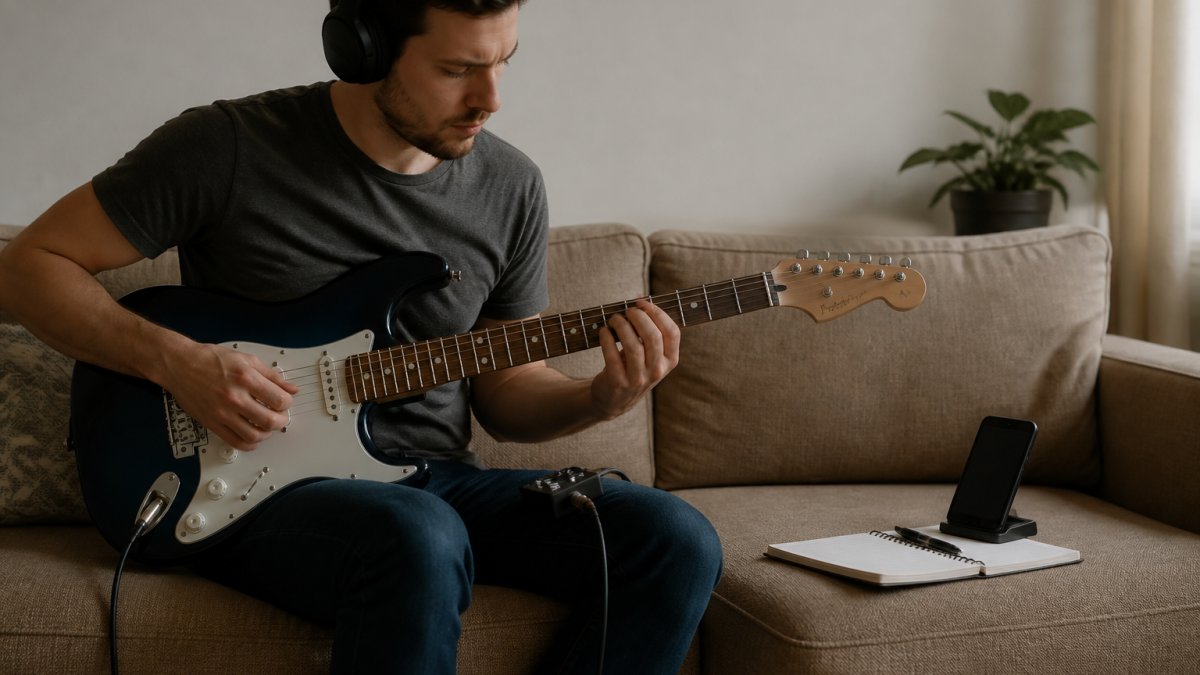
Here is how we would split it:
- 5 min: Warm up with chromatic exercises and light stretching
- 10 min: One technique target, played slowly with a metronome
- 10 min: Learn or polish one song section
- 5 min: Free play and review what felt shaky
A headphone amp makes this routine practical at home. The Fender Mustang Micro plugs straight into your guitar and runs through headphones, so you can practice quietly with amp tones and stream backing tracks over Bluetooth.

Mastery, Competence, and the Goals That Actually Matter
Mastery is a direction, not a destination. For most players, competence, the ability to play songs you love cleanly and confidently, is the goal worth chasing.
Define your own finish line:
- Casual player: play favorite songs around a campfire
- Hobbyist: handle barre chords, scales, and improvisation
- Gigging musician: perform live with clean technique and stage-ready gear
- Master: decades of deliberate practice across styles
The 10,000-hour figure is really about the last group. For everyone else, the question is not "how do I hit 10,000 hours" but "what do I want to play, and what practice gets me there fastest?"
When you are ready to move up, our team inspects and sets up every instrument before it ships, so your practice time goes into playing, not fixing.
Frequently Asked Questions
How many hours on average does it take to learn guitar?
There is no fixed number, but a practical frame helps. Most beginners can play recognizable songs after roughly 20 to 50 hours of focused practice, and can move through basic chords and rhythm confidently somewhere between 100 and 300 hours. The 10,000 hour rule describes the extreme end of expertise, not the beginner stage. Spreading those hours across short daily sessions beats long weekend marathons, because repetition with feedback is what builds muscle memory and ear training.
Does practicing guitar for 10,000 hours guarantee mastery?
No. The 10,000 hour rule is a rule of thumb, not a promise. Hours spent repeating the same comfortable riff build very little, while focused practice with a specific goal, immediate feedback, and steady difficulty increases does. A player who logs 10,000 hours of unfocused noodling may still struggle with new techniques. Treat the number as a reminder that mastery takes years, then focus on what you do inside each session rather than the total on the clock.
How many hours a day should a beginner practice guitar?
Twenty to thirty minutes a day is enough to make steady progress in the first year, and it is far more sustainable than an hour once a week. A 30-minute guitar practice routine split into warm-up, technique, chord changes, and one song keeps you engaged without fatigue. If you have more time, add a second short session rather than one long one. Consistency across weeks matters more than any single day's total.
Can I learn guitar in 7 days?
You can learn a few chords and a simple riff in a week, but not guitar playing as a skill. In seven days most beginners can form open chords like E minor and A major, and strum a basic pattern. What you cannot build in a week is clean chord transitions, rhythm stability, or the finger strength that comes from repetition over months. Use the first week to set up a guitar practice schedule for beginners and build the habit that carries you further.
The 10,000-hour path is long, but the first 100 hours are where most players quit. Give yourself gear that plays well out of the box and a routine you can actually keep. Specialty Traders offers new and used guitars backed by over 25 years of experience, a thorough inspection and setup on every instrument, and free US shipping on most items, so you can start practicing with confidence. Shop now and find the guitar that fits your goals.