

Table of Contents
- What a Guitar Setup Actually Changes
- How Guitar Action and Neck Relief Affect Tone and Feel
- Guitar Intonation Adjustment: Why Chords Sound Out of Tune Up the Neck
- Pickup Height, String Pull, and Output Balance
- Signs Your Guitar Needs a Setup
- How Often to Get a Guitar Setup
- When a Setup Won't Fix the Problem
- Frequently Asked Questions
Last Updated: October 17, 2026
What a Guitar Setup Actually Changes
A guitar setup is the process of adjusting an instrument's neck, string height, intonation, and pickup position so it plays cleanly and stays in tune. At Specialty Traders, we inspect and set up every instrument before it ships, because the difference between a guitar that fights you and one that plays itself rarely comes down to price. It comes down to adjustment.
Here is the part most guides get wrong: a setup does not add tone. It removes the things blocking the tone your guitar already has.
The Five Adjustment Points That Shape Your Sound
Every setup touches five points. Each one changes how the string behaves, and how the string behaves is what you hear.
- Neck relief sets the curve of the fretboard.
- String action sets how high the strings sit.
- Intonation sets whether notes stay in tune up the neck.
- Pickup height sets output and balance.
- Nut and saddle condition sets string travel at both ends.
Change one, and the others shift. That is why a proper setup is a sequence, not a single tweak.
How Guitar Action and Neck Relief Affect Tone and Feel
Guitar action and neck relief work as a pair. Relief is the slight forward bow in the neck, measured with a capo at the first fret and a feeler gauge at the eighth. Action is the height of the strings above the frets.
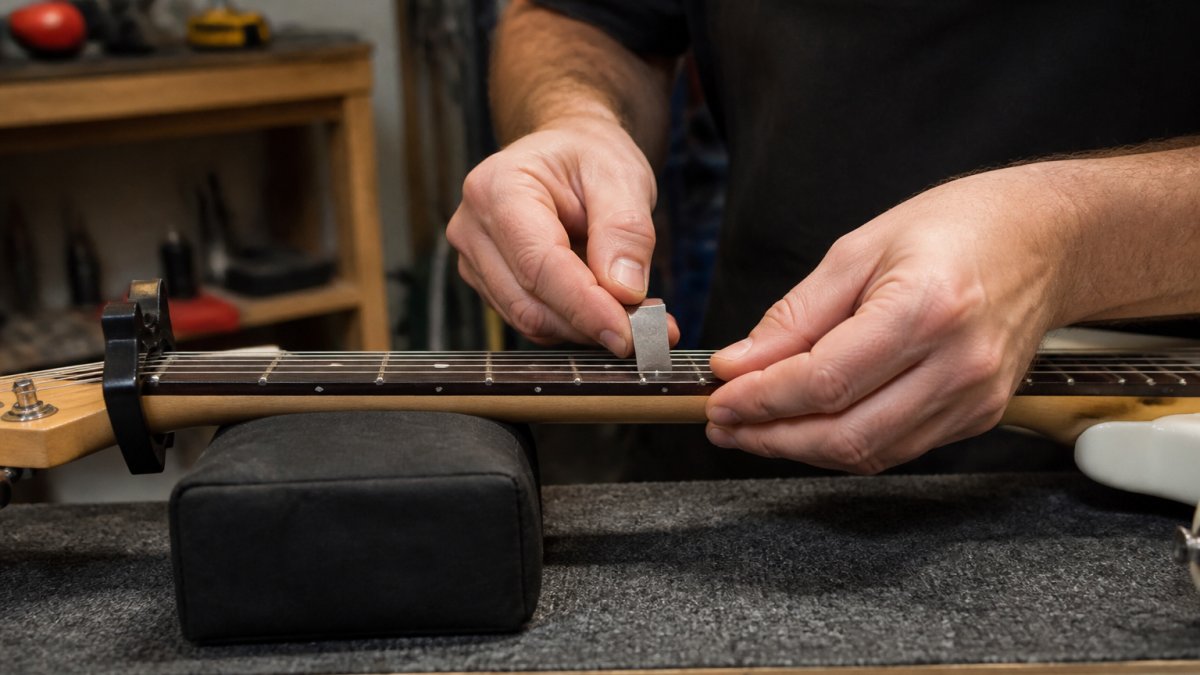
Too little relief causes fret buzz and kills sustain. Too much makes the guitar feel stiff and pushes notes sharp when you press down. Either way, the string cannot vibrate freely, and free vibration is what you hear as resonance.
Reading Relief and Setting String Height
Measure relief first. Then set action. Then check intonation. Skip that order and you will chase problems in circles.
A common mistake is lowering action to chase playability without checking relief. The guitar feels fast for a week, then buzzes everywhere.
Guitar Intonation Adjustment: Why Chords Sound Out of Tune Up the Neck
Guitar intonation adjustment matches each string's speaking length to its pitch so open strings and fretted notes agree. If your open E is perfect but the same string at the twelfth fret reads sharp, intonation is off. The fix is saddle position: move the saddle back and the fretted note flattens, move it forward and it sharpens.
That is the standard explanation, and it is where most guides stop. The useful part is understanding why intonation errors are so audible on some chords and invisible on others, and what a correct setup actually buys you in tone terms.
Why Chords Expose Intonation Errors That Single Notes Hide
A chord stacks intervals, and intonation errors compound across strings. A D chord voiced in the open position uses fretted notes on the G, B, and high E strings at the second and third frets, plus the open D.
This is why players blame their ears or their tuner. The tuner is right about the open strings. The saddles are wrong about the fretted ones.
Benchmarks and a Listening Test You Can Run
A common starting benchmark is that the fretted note at the twelfth fret should match the twelfth-fret harmonic within a few cents, and most practitioners aim to get every string inside that window before calling the job done.
You can hear the difference without a strobe tuner. Play a clean open D chord, then a D barre at the tenth fret. If the barre sounds noticeably worse than the open chord, intonation is suspect. Then play the twelfth-fret harmonic on each string and the fretted note at the twelfth fret back to back.
The Trade-Off Intonation Cannot Solve
Perfect intonation across all twenty-two frets is not physically possible on a standard guitar, because equal temperament and fixed saddles are an approximation. A good setup gets every string close enough that no chord sounds wrong, but it cannot make a guitar perfectly in tune in every key. According to Fender's guide to guitar setup, intonation should always be checked last, after relief and action are set, for exactly this reason.
Pickup Height, String Pull, and Output Balance
Pickup height is the most overlooked tone control on the guitar, and it is the one adjustment that changes output, balance, and sustain without touching a single note you play. A pickup is a magnetic circuit. The closer the pole pieces sit to the string, the more string movement crosses the magnetic field, and the hotter the signal that reaches your amp. That is the whole mechanism, and it cuts both ways. Excessive magnetic pull can dampen string vibration and introduce unwanted artifacts, making it essential to balance these physical adjustments with a consistent picking tone to maintain clarity across the entire fretboard.
What Moving a Pickup Actually Does to the Signal
Lower the pickup and you lose output, but you also lose magnetic string pull. The string vibrates more freely, which most players hear as slightly more sustain and a more open top end. Raise the pickup and you gain output and midrange push, but the magnet starts to damp the string's travel.
That is why pickup height is a balance, not a maximum. You are trading output against string freedom, and the right setting depends on how hard you pick and how much headroom your amp has.
Setting Height by Ear and by Measurement
Start with the bass side slightly lower than the treble side, because the low strings generate more output and need more clearance.
SIT Strings S946 Rock N' Roll Power Wound Nickel Electric Guitar Strings 3 Pack →
Most practitioners find a useful starting range is roughly 1/8 inch between the string and the pole piece on the bridge pickup, with the neck pickup set a little lower to compensate for wider string travel.
The Trade-Off You Are Actually Making
There is no free lunch here. Closer pickups give you more output and a fatter midrange, but you pay in string pull, sustain, and balance between strings. Farther pickups give you clarity and string freedom, but you may need more gain at the amp to compensate. The goal is not the hottest possible signal.
If you play with heavy picking or use high-output pickups, bias toward more clearance. If you play softly with vintage-style pickups, you can sit closer. Either way, check the result with your ears at performance volume, not bedroom volume, because output balance shifts as the amp compresses.
Signs Your Guitar Needs a Setup
The signs your guitar needs a setup are usually obvious once you know what to listen for. Buzz on open strings. Chords that sound wrong past the fifth fret. Action that feels higher than it did last month. Notes that fade fast instead of ringing.
Season changes matter too. Wood moves with humidity, and a neck that was perfect in summer can shift by fall.
- Fret buzz on open or fretted notes
- Chords out of tune up the neck
- Strings that feel stiff or too slinky
- Uneven volume between strings
- Notes that die quickly instead of sustaining
If two or more of these show up, book the work.
How Often to Get a Guitar Setup
How often to get a guitar setup depends on use. A gigging player should get one every few months. A home player can go a year between setups. New strings alone do not count as a setup.
Change string gauge and you need a fresh setup. Heavier strings pull harder on the neck, which changes relief and intonation together.
Matching Setup Specs to Playing Style and Tuning
Setup specs are not universal. A slide player wants higher action and heavier strings. A shredder wants low action and light strings. Drop tunings need heavier gauges to keep tension.
Our SIT Strings S1046 Light Power Wound Nickel 3 Pack suits standard tuning and light action. Players who tune down should look at the SIT Strings S1052 Heavy Bottom set, which keeps the low end tight under lower tunings. Both run $19.99 for three sets.


| Playing Style | Action | String Gauge | Setup Priority |
|---|---|---|---|
| Shred / fast lead | Low | Light | Low action, clean relief |
| Rhythm / chords | Medium | Medium | Intonation accuracy |
| Slide | Higher | Heavy | Clean clearance, sustain |
| Drop tunings | Medium | Heavy bottom | Tension and tuning stability |
When a Setup Won't Fix the Problem
A setup cannot fix worn frets, a twisted neck, or a lifting bridge. Those are repair jobs, not adjustments.
Uneven frets cause buzz that no action height will cure. A neck warp shows up as different relief on the low and high sides. Both need a tech, not a truss rod turn.
This is why we check every instrument before it ships. A used guitar can look clean in photos and still have worn frets. Our team inspects each one so you know what you are getting. If a guitar arrives with an issue, our return policy covers condition that does not match the listing.
Frequently Asked Questions
Does a professional guitar setup actually improve tone?
It improves the conditions tone depends on. Correct neck relief and string action let each string vibrate cleanly, so you get more sustain and clarity instead of fret buzz choking notes. Proper intonation makes chords sound in tune across the fretboard, and balanced pickup height evens out volume between strings. A setup won't turn a budget instrument into a vintage one, but it removes the mechanical problems masking the sound your guitar already has.
How do action and neck relief affect guitar tone?
Action that is too low causes fret buzz and kills sustain; too high makes the guitar hard to play and pulls notes sharp when you press down. Neck relief, the slight forward bow measured at the 7th or 8th fret, controls how much room the strings have to vibrate. A truss rod adjustment that sets relief correctly lets strings ring freely without buzzing, which is where clearer tone and steadier tuning come from.
How often should you get a guitar setup?
Most players benefit from a setup once a year, or twice a year if the guitar gigs regularly or lives in a climate with big seasonal humidity swings. Change string gauge, switch tunings, or move to a new climate and you should book one sooner. Players who notice tuning instability, buzzing, or rising action should not wait for a calendar date; those are signs your guitar needs a setup now.
Can you do a guitar setup yourself?
Basic tasks like changing strings and adjusting pickup height are reasonable DIY jobs with the right screwdriver and a ruler. Truss rod and intonation adjustments are less forgiving: a quarter turn too far can cause fret buzz or a back-bowed neck, and correcting it may need a professional. If you are unsure, a tech with the right gauges and a straightedge will diagnose and calibrate faster than trial and error.
A guitar that will not stay in tune or rings unevenly is telling you something. Sometimes it needs an adjustment, and sometimes it needs a better instrument. Specialty Traders has spent over 25 years matching players with gear that works, and every instrument we sell gets a quality check and setup before it leaves. Browse our selection of new and used guitars and basses, with free shipping on most items, and start with an instrument that plays right from day one.