

Last Updated: October 26, 2026
Quick Summary
Yes, is a used guitar worth it for beginners when you know what to look for. A $150 used guitar often plays better than a $150 new one, offers proven durability, and frequently comes with setup already done. The key is inspecting for structural damage, playability issues, and understanding total cost of ownership beyond the purchase price.
- A used guitar in the $100-$200 range is the sweet spot for beginners with decent brands and good condition.
- Check for structural cracks, neck straightness, fret wear, and test all electronics before buying.
- Budget $50-$150 for professional setup, $8-$15 for new strings, and potentially $100-$250 for fret work if needed.
- Buy from retailers with inspection and return protection when purchasing online to avoid scams and hidden damage.
- Used guitars retain resale value better than new budget guitars, lowering your true cost of ownership.
Table of Contents
- Is a Used Guitar Worth It for Beginners?
- Used vs. New Guitar for Beginners: What Matters Most
- How to Inspect a Used Guitar: A Step-by-Step Checklist
- Used Guitar Price Guide: Understanding Real Value
- Buying a Used Guitar Checklist: Before You Commit
- Private Sellers vs. Retailers: Where to Buy Used
- Finding Your First Used Guitar at Specialty Traders
- Frequently Asked Questions
Is a Used Guitar Worth It for Beginners?
Whether a used guitar is worth it for beginners depends on knowing what to look for.
Beginners don't need new, they need playable.
At Specialty Traders, we've spent over 25 years in the retail music industry.
Used vs. New Guitar for Beginners: What Matters Most
The core question is whether the specific guitar is worth the price.
Used guitars offer real advantages:
- Better quality at your budget. A $150 used guitar often plays better than a $150 new one, and used inventory includes higher-end models that have depreciated.
- Proven durability. A used guitar that's survived years of playing has proven it won't fail. New instruments occasionally have manufacturing defects.
- Setup already done. Many used guitars sold by retailers have been inspected and adjusted. You get playability out of the box.
New guitars have one real advantage:
- Warranty and return protection. If something goes wrong, you have recourse. Used guitars sold by private sellers typically come as-is.
How to Inspect a Used Guitar: A Step-by-Step Checklist
When inspecting a used guitar, look for structural damage, playability issues, and cosmetic wear.
Visual Inspection and Body Condition
Look at the body under bright light from multiple angles.
Check for:
- Cracks in the wood. Small surface cracks are cosmetic. Deep cracks running across the body or near the neck are structural problems. Structural cracks affect sound and can worsen over time.
- Water damage. Dark stains, warping, or soft spots indicate moisture exposure. Avoid these.
- Finish damage. Scratches and dings don't affect playability. Fading or peeling finish is cosmetic. Both are fine for a beginner.
- Hardware condition. Tuning pegs should turn smoothly. Bridge and strap buttons should be secure. Rust on hardware is a sign of age but not usually a deal-breaker unless severe.
Neck and Fretboard Assessment
What to check:
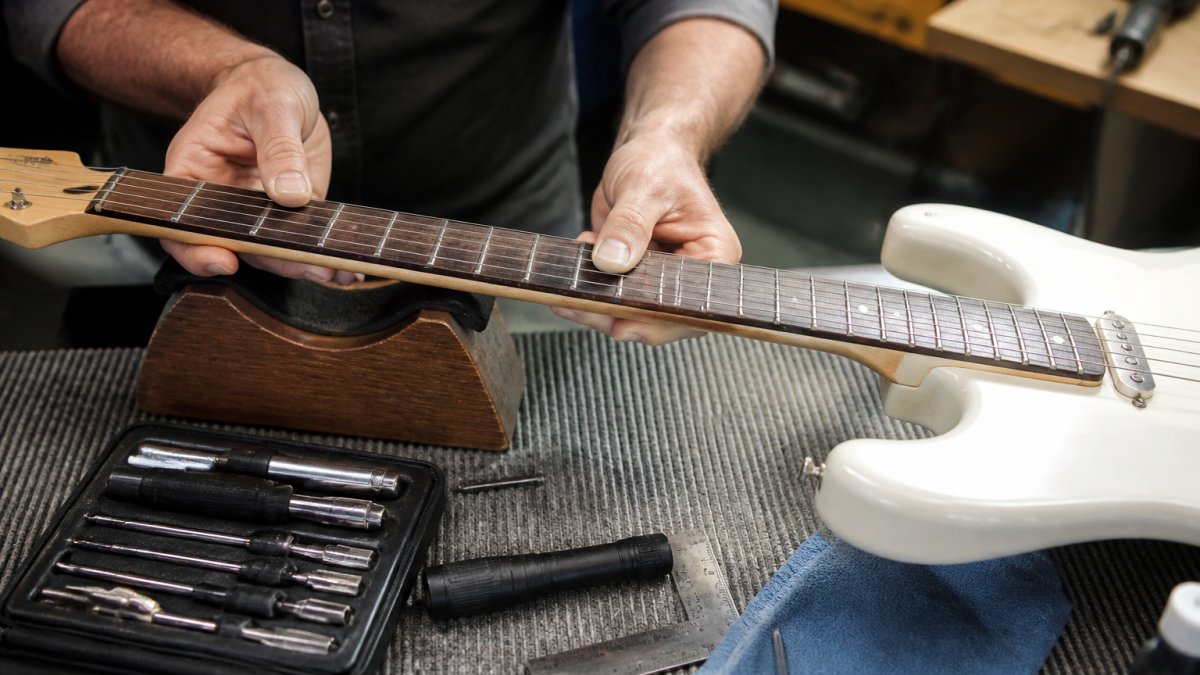
- Straightness. Sight down the neck from the headstock toward the body. The frets should form a straight line. A neck that bows forward or backward affects playability and can't be fixed cheaply.
- Fret wear. Run your finger along the frets. Worn frets feel flat or grooved. Light wear is normal on used guitars. Heavy wear makes the guitar harder to play in tune and requires professional fret leveling (expensive).
- Fretboard condition. Look for deep cracks, warping, or missing material. The fretboard should be smooth and even. Dried-out fretboards can crack. This is a warning sign.
- Neck pocket fit. At the headstock, check if the neck is cracked or splintered. At the body, the neck should fit snugly in the pocket with no gaps or movement.
Electronics and Hardware Check
For electric guitars, test everything that makes sound.
Test:
- All pickups. Switch between them. Each one should produce sound without crackling or cutting out.
- Volume and tone controls. Turn them smoothly through their full range. They should feel responsive and not crackle or cut out.
- Output jack. Plug in a cable. It should connect firmly and produce sound without noise.
- Tremolo system (if equipped). Move the arm through its range. It should return to pitch smoothly without getting stuck.
Used Guitar Price Guide: Understanding Real Value
A used guitar's value depends on brand, condition, age, and market demand, not on what someone paid new. Learn how to get fair trade-in value for instruments when you're ready to upgrade.
Realistic price ranges for beginner-friendly used guitars:
- Under $100. Budget brands, significant wear, or older instruments. Playable but limited. Good for testing if you'll stick with guitar.
- $100-$200. Sweet spot for beginners. Decent brands, good condition, playable out of the box. Examples include the Silvertone SS11 at $119 and the Jay Turser JT-100 at $119.
- $200-$400. Higher-end beginner or entry-level intermediate guitars. Better build quality, nicer hardware, more refinement.
- $400+. Intermediate or professional-grade instruments. Overkill for a true beginner but worth it if you're upgrading from a starter.
The Number Beginners Forget: Total Cost of Ownership
- Professional setup: roughly $50-$150. This covers truss-rod adjustment, action height, intonation, and sometimes fret polishing. Many used guitars play acceptably as sold, but a setup is the single biggest playability upgrade for a beginner. Budget for it unless the seller confirms a recent setup.
- Strings: roughly $8-$15 per set. Assume you'll change strings soon after purchase. Old strings feel stiff, sound dull, and go out of tune, which makes practice discouraging.
- Fret work, if needed: roughly $100-$250 for a level and crown. Heavy fret wear is the most common hidden cost on older used guitars. If the frets are grooved, factor this in or walk away.
- Electronics repair, if needed: roughly $50-$300. A scratchy potentiometer or a dead pickup turns a bargain into a project. Test everything before paying.
- Case or gig bag: roughly $30-$100. Protection is not optional if the guitar leaves the house.
- Accessories: roughly $20-$60. Picks, a tuner, a strap, and a cable for electric guitars. These are small line items that add up fast.
How to Judge Whether a Price Is Fair
Finally, resale value cuts in your favor. A used guitar bought fairly can usually be sold for close to what you paid, lowering the cost of finding out whether guitar is for you. A new budget guitar loses value the moment it leaves the store.
Peavey Raptor Plus EXP Black Electric Guitar & Bag #0796 Used →
Here are the typical price ranges for beginner-friendly used guitars and what to expect at each level.
| Price Range | What You Get | Examples |
|---|---|---|
| Under $100 | Budget brands, significant wear, playable but limited | Good for testing commitment |
| $100-$200 | Sweet spot for beginners, decent brands, good condition | Silvertone SS11 at $119, Jay Turser JT-100 at $119 |
| $200-$400 | Higher-end beginner or entry-level intermediate guitars | Better build quality and hardware |
| $400+ | Intermediate or professional-grade instruments | Overkill for true beginners |
Buying a Used Guitar Checklist: Before You Commit
Before buying, consider these checklist items.
Condition and playability:
- [ ]
- [ ]
- [ ]
- [ ]
- [ ]
- [ ]
Purchase protection:
- [ ]
- [ ]
- [ ]
- [ ]
Practical readiness:
- [ ]
- [ ]
- [ ]
Private Sellers vs. Retailers: Where to Buy Used
Private sellers offer:
- Lower prices. No middleman markup. You negotiate directly.
- No return option. Most private sales are final. If the guitar has hidden problems, that's your loss.
- Variable quality. Some private sellers are knowledgeable and honest. Others aren't.
- No setup guarantee. The guitar arrives as-is. You may need to pay for setup.
Retailers offer:
- Inspection and setup. Reputable retailers inspect every instrument and set it up before shipping. You get a playable guitar.
- Return protection. Most retailers accept returns if the condition description doesn't match.
- Accountability. The retailer's reputation is on the line. They're motivated to get it right.
- Higher prices. You pay for the service and protection.
Buying Used Online: The Rules That Protect You
Use a payment method with buyer protection. Pay with a credit card or a platform payment service that offers dispute resolution. A credit card gives you the right to dispute a charge for goods that arrive materially different from the description, and major card networks set clear rules for those claims (What To Do if You’re Billed for Things You Never Got, or You Get Unordered Products). Avoid cash transfers, gift cards, and peer-to-peer apps with no purchase protection. If a seller insists on a method with no recourse, that is the warning sign, not the price.
Verify the seller before you pay. Look for an account with a real history, prior sales, and reviews that mention instruments specifically. Reverse-image-search the listing photos; stolen photos are one of the most common signs of a scam. Ask for a photo of the serial number and a short video of the guitar being played through an amp. A legitimate seller can produce these quickly. A scammer usually stalls or sends generic images.
Confirm the return terms in writing. Ask directly: "If the neck is not straight or the electronics are noisy, can I return it, and who pays return shipping?" Get the answer in a message before paying. Retailer listings usually state a return window; private listings usually do not. The absence of a stated policy is itself information.
Plan for shipping damage. Used guitars ship in cases or gig bags, and damage in transit is a real risk. Ask how the guitar will be packed, and inspect the box before signing for it. If the box is crushed or rattling, photograph it before opening and note the damage with the carrier. Keep all packaging until you have tested the instrument, because a damage claim usually requires it.
A Simple Decision Rule
- You can inspect in person and bring an experienced player: a private sale is reasonable and often the best value.
- You can inspect in person but have no experienced help: buy from a retailer with a return policy, or ask the seller to meet at a shop that can check the guitar.
- You are buying online and cannot inspect: buy only from a retailer or a platform with buyer protection and a stated return window, and pay with a method that gives you recourse.
Finding Your First Used Guitar at Specialty Traders
At Specialty Traders, every instrument undergoes a thorough inspection and setup for proper functionality before shipping. Protect your used guitar with a gig bag designed for electric guitars. Browse guitar cases and protective gear to keep your instrument safe.
The Peavey Raptor Plus EXP is listed at $149.00, and the Silvertone SS11 is listed at $119.00. See real examples of used guitars with cases available for purchase.
Frequently Asked Questions
Is a used guitar worth it for beginners?
Yes, a used guitar can be worth it if you inspect it carefully. The key is knowing what to look for: fret wear, neck damage, electronics, and setup condition. Specialty Traders inspects and sets up instruments for proper functionality before shipping.
What should a beginner check before buying a used guitar?
Start with the basics: look for cracks or deep scratches on the body, check the neck for warping or bending, and inspect the fretboard for significant wear. Test the tuning stability by playing each string and letting it ring. Try the electronics if possible, all pickups should work, switches should click cleanly, and the volume knob should turn smoothly. Bring an experienced player if you can.
How much should a beginner spend on a used guitar?
Specialty Traders lists the Silvertone SS11 and Jay Turser JT-100 at $119.00 each. The Silvertone listing notes scratches on the body and a worn gig bag with a bad accessory-pouch zipper; the Jay Turser listing notes a neck pocket crack.
Is it safe to buy a used guitar online?
Specialty Traders inspects and sets up instruments for proper functionality before shipping and offers free US shipping on most items. Review the condition description for the specific instrument you're considering.
Is a used guitar worth it for beginners? Yes, when you buy smart. The right used guitar teaches faster, costs less, and often plays better than a budget new alternative. The key is inspection, realistic expectations, and buying from a source that stands behind what they sell. Start with the checklist above, ask questions, and don't rush. A guitar that fits your budget and plays well keeps you practicing. That's what matters.
