

Last Updated: October 30, 2026
Quick Summary
Determining your used guitar worth starts with a used guitar price guide, but the real number comes from matching your instrument to recent completed sales. Identify the exact brand, model, and year, grade the condition honestly, then use the median of three to five sold listings as your baseline. Adjust that baseline for condition and originality to set your asking price.
- A used guitar price guide is a reference list of recent market prices, not a final answer.
- Pull three to five completed sales and use the median so one outlier does not inflate your ask.
- Condition adjustments run from up to 10% above baseline for excellent down to 50% or more below for poor.
- A trade-in calculator estimates what a dealer will pay you, so treat its result as a floor.
- Compare selling methods on net proceeds, since a shipped private sale at $1,200 can net less than a local sale at $1,050.
Table of Contents
- Start With a Used Guitar Price Guide, Not a Guess
- How to Assess a Guitar's Value Step by Step
- Use a Used Guitar Trade-In Value Calculator the Right Way
- Fees, Shipping, and Net Proceeds by Selling Method
- How to Sell a Used Guitar Without Leaving Money on the Table
- Vintage, Rare, and Modified Guitars: Where Valuations Go Wrong
- Get a Real Offer on Your Guitar From Specialty Traders
- Frequently Asked Questions
Start With a Used Guitar Price Guide, Not a Guess
Figuring out the used guitar worth starts with research, not a number pulled from memory. A used guitar price guide gives you a baseline, but the real answer comes from matching your instrument to recent sales.
A used guitar price guide is a reference list of recent market prices for specific makes and models in specific conditions. It works as a starting point, not a final answer.
Here is what most sellers get wrong. They look up one number, then list at it. Real value depends on four things:
- The exact brand, model, and year
- The condition, graded honestly
- What similar guitars actually sold for
Below, we walk through a step-by-step worksheet you can run in an afternoon.
How to Assess a Guitar's Value Step by Step
Assessing a guitar's value means comparing your instrument to recent sales of the same model in similar condition, then adjusting for wear, parts, and demand. Do it in order. Skip a step and your estimate drifts.
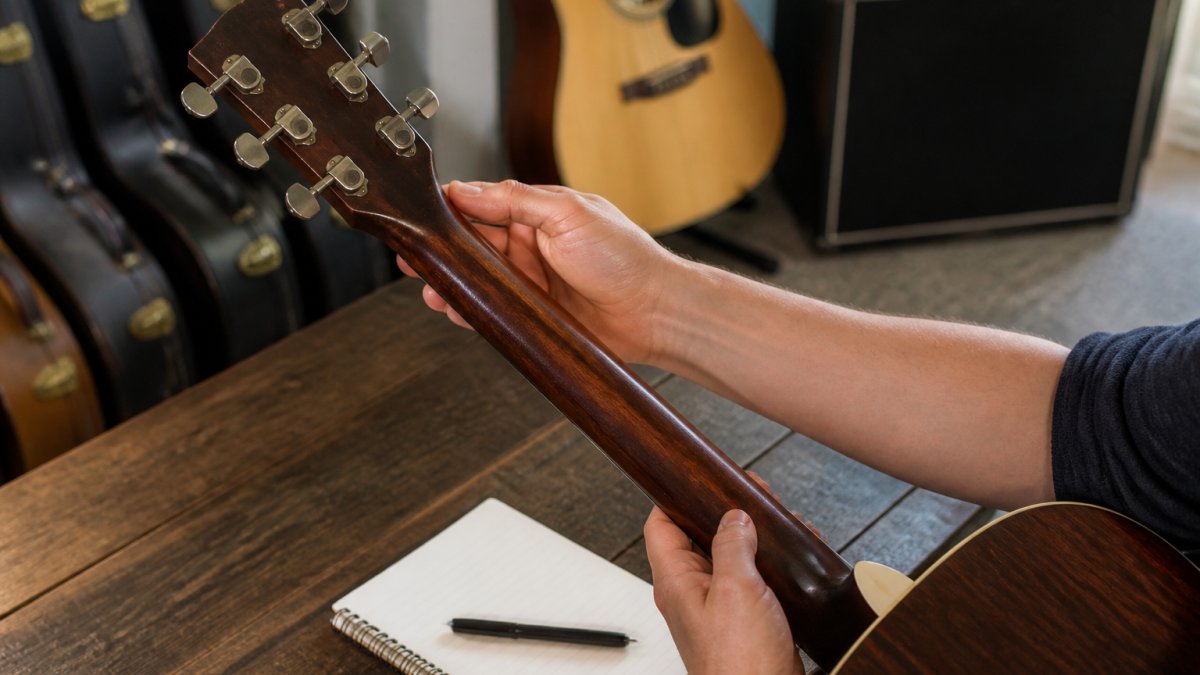
The Valuation Worksheet
Copy these six lines into a notebook or spreadsheet. Fill them in top to bottom. Each line feeds the next.
| Line | What to Record | Example Entry |
|---|---|---|
| 1. Identity | Brand, model, year, serial number | Gibson SJ Deluxe, 1974, serial 123456 |
| 2. Condition grade | Excellent / Very Good / Good / Fair / Poor | Good |
| 3. Baseline sold price | Median of 3-5 recent completed sales, same model and year, similar grade | $2,400 |
| 4. Condition adjustment | Percentage up or down from baseline | −15% |
| 5. Originality adjustment | Percentage up or down for replaced parts or repairs | −10% |
| 6. Your asking price | Baseline × (1 + adjustments) | $1,800 |
That last number is your starting ask, not your floor. You will refine it in the selling-method section.
Step 1: Identify the Exact Brand, Model, and Year
Start with the label inside the soundhole or the back of the headstock. Write down the serial number. Then confirm the model and year against the maker's own records.
Serial numbers are the fastest way to pin down a year. Check the maker's official serial guide rather than a forum post. If the maker's records are incomplete, a reputable vintage dealer or an established price guide can help confirm the production window.
Step 2: Grade the Condition Honestly
Grade your guitar on a simple scale: excellent, very good, good, fair, poor. Be strict. Buyers will be.
- Excellent: light scratches only, no repairs
- Very good: minor wear, all original parts
- Good: visible play wear, small cosmetic flaws
Condition grades are subjective, so anchor yours to evidence. Photograph every flaw in raking light, note the location and size, and compare against sold listings that describe similar wear. If you are unsure how to grade wear, how to verify used guitar condition walks through the checks step by step.
Step 3: Separate Completed Sales From Asking Prices
This is the step that decides your number. An asking price is a wish. A completed sale is a fact. Search sold listings for your exact model and year, then record the final price, the date, and the condition.
A real listing helps here. Our used PRS SE Swamp Ash Special in Vintage Sunburst shows how a specific used guitar is priced against its condition and finish.
| What You Find | What It Tells You |
|---|---|
| Asking price | Seller's hope, often high |
| Completed sale | Real market value |
| Trade-in offer | Wholesale floor |
| Retail used price | Ceiling with a warranty |
Step 4: Apply Condition and Originality Adjustments
Once you have a baseline from completed sales, adjust it. Guitar values are usually adjusted in rough bands rather than exact percentages, because every guitar is different. A common pattern looks like this:
- Excellent: baseline, or up to 10% above if the model is in demand
- Very good: baseline
- Good: 10-20% below baseline
Then adjust for originality. Replaced pickups, a refinished body, a swapped bridge, or a repaired headstock crack all pull value down, even when the work is good. Documented repairs are better than hidden ones, but they still cap the price. Original parts in the case or a documented service history can push a price back up.
Step 5: Sanity-Check Against the Market
Before you list, compare your number to current asking prices for the same model. If your ask is far below the market, you have probably been too harsh on condition or missed a demand spike. If it is far above, you are likely pricing from hope. A quick check of how long comparable listings have been sitting tells you whether the market is moving or stalled.
Use a Used Guitar Trade-In Value Calculator the Right Way
A used guitar trade-in value calculator estimates what a dealer will pay you, not what a private buyer will. Those are different numbers, and the gap is normal. Dealers build in room for inspection, setup, and resale.
Gibson 1970's SJ Deluxe Southern Jumbo Sunburst Acoustic Guitar & Case #A600241 →
Treat any calculator result as a floor. Then compare it to your completed-sale research. If the calculator says one number and recent sales say another, trust the sales.
- Trade-in offers are fast and low-risk
- Private sales take longer but usually pay more
- Fees and shipping eat into the private-sale gap
Fees, Shipping, and Net Proceeds by Selling Method
Net proceeds are what you keep after fees, shipping, and any repair costs. A higher sale price means little if the costs erase the difference. Compare methods on net, not gross. This is the step most sellers skip, and it is where a "higher" sale price quietly turns into a smaller check.
What Each Method Actually Costs
Costs vary by platform and by guitar, but the categories are consistent. Here is what to expect and where the money goes.
| Method | Typical Costs | Speed | Net to You |
|---|---|---|---|
| Private sale (local) | Payment fees only if paid electronically; no shipping | Slow | Highest, minus minimal costs |
| Private sale (shipped) | Listing fee, payment processing, packing materials, insured shipping | Slow | High, but shipping can take a large bite on bulky cases |
| Online marketplace | Final-value fee, payment processing, shipping, possible return shipping | Medium | Middle |
| Consignment | Dealer commission, often a percentage of sale price | Medium | Middle |
| Trade-in | None to you | Fast | Lowest |
A Worked Net-Proceeds Example
Suppose your completed-sale research puts a guitar at $1,200. Run the same guitar through each method using representative costs.
- Local private sale: Sell for $1,200, accept cash or a fee-free payment. Net: about $1,200.
- Shipped private sale: Sell for $1,200. Subtract packing materials, insured shipping, and payment processing. On a full-size acoustic in a hard case, shipping and insurance alone can run well over $100, and packing supplies add more. Net: meaningfully below $1,200.
- Online marketplace: Sell for $1,200. Subtract the platform's final-value fee, payment processing, and shipping. The fee alone can take a double-digit percentage. Net: lower still.
The lesson: a shipped private sale at $1,200 can net less than a local private sale at $1,050. Price the method, not just the guitar.
How to Choose
- If you have a local buyer pool and the guitar is common, a local private sale usually nets the most.
- If the guitar is rare and buyers are far away, shipping may be unavoidable, so build the cost into your ask.
- If speed matters more than the last dollar, trade-in or consignment removes the listing and shipping work.
Run your own numbers on the worksheet from the valuation section. The method with the highest gross price is not always the method with the highest net.
How to Sell a Used Guitar Without Leaving Money on the Table
Selling a used guitar for top dollar comes down to presentation and proof. Clean it, photograph it in good light, and list every flaw. Buyers trust sellers who show the scratches.
- Shoot the front, back, headstock, and any damage
- Note the serial number in the listing
- State the condition grade and any repairs
If you would rather skip the listing, shipping, and haggling, we buy used gear directly. Our team inspects every instrument before it ships, and we offer free US shipping on most items.
Vintage, Rare, and Modified Guitars: Where Valuations Go Wrong
Vintage and modified guitars break the normal rules. Rarity can push a price up, but only when the right buyer is looking. Modifications usually pull value down, even good ones.
A 1970s Gibson SJ Deluxe with a repaired top split and a replaced bridge pin is a good example. The repair is common for that era, and it caps the price rather than killing the sale.
- Original parts raise value; replacements lower it
- Documented repairs are better than hidden ones
- Rarity helps only with the right buyer
Get a Real Offer on Your Guitar From Specialty Traders
Every seller faces the same question about used guitar worth: is my number right, or am I guessing? You can spend a weekend researching sold listings, or you can get a real offer from people who inspect guitars every day.
We are a family-owned shop with over 25 years in the retail music industry. Every instrument we take in gets a quality check before shipping.
Get started with Specialty Traders and turn your used guitar into a fair, no-guesswork offer.
Frequently Asked Questions
How much should I pay for a used guitar?
Start with the new retail price and expect to pay roughly 50 to 70 percent of it for a used instrument in good shape, less if there is visible wear or missing original parts. Check completed sales on listings for the same model and year, not just asking prices. A used guitar worth $800 new might realistically sell for $450 to $550 privately. Always factor in a setup or fretwork if the guitar has been sitting unplayed.
How does a guitar's condition affect its resale value?
Condition is the biggest swing factor after brand and model. Light scratches and play wear typically cost you 10 to 20 percent off a clean example. Finish cracks, headstock repairs, or replaced pickups can cut value by 30 percent or more. Original parts matter: a guitar with its factory case, pickguard, and electronics intact sells for noticeably more than one with swapped components. Photograph every flaw so buyers trust your description.
Where can I check recent selling prices for used guitars?
Look at completed and sold listings on major marketplaces, then filter to the same model and approximate year. Asking prices are not evidence; only closed sales show what buyers actually paid. A used guitar price guide gives you a baseline range, but local demand and season matter. Compare at least five completed sales before you settle on a number, and note whether shipping was included.
Should I sell my guitar privately or take a trade-in offer?
A private sale usually nets more money but takes time, and you handle fees, shipping, and buyer questions. A trade-in or buyout offer from a shop is faster and removes the hassle, though the offer will sit below private-sale value because the buyer needs margin to resell it. Use a used guitar trade-in value calculator to see the gap, then decide whether your time is worth the difference.
Ready to stop guessing? Send us the details on your guitar, and our team will give you a straight answer on what it is worth.
