

Last Updated: November 10, 2026
Quick Summary
Used guitar fretwork is usually reliable if you inspect it, since most guitars leave the factory with decent fretwork and hold up for years. Check for level height, seated edges, smooth crowns, clean ends, and even shine, and watch for buzz, choked bends, or snagged edges that signal high, loose, or worn frets.
- Sight down the neck and rock a fret rocker across three frets to find high spots.
- Tap each fret end lightly; a hollow click means an unseated or loose fret.
- Buzz at one or two frets points to fret problems, while buzz everywhere points to setup.
- A fret dress levels, crowns, and polishes frets without replacing them.
- Nickel frets wear faster than stainless steel, so measure remaining height closely.
Table of Contents
- What Reliable Fretwork Looks and Feels Like
- How to Check Guitar Frets Before You Buy
- Spotting Used Guitar Fret Wear That Actually Matters
- Guitar Fret Buzz Causes and How to Tell Them Apart
- Leveling, Crowning, and Polishing: What a Fret Dress Fixes
- Guitar Refret Cost and How to Weigh It Against the Price
- Learning Fretwork Safely on a Cheap Guitar
- Buying a Used Guitar With Frets You Can Trust
- Frequently Asked Questions
What Reliable Fretwork Looks and Feels Like
Reliable fretwork is fretwork you can trust under your fingers: every fret sits level, seated, and smooth, so each note rings clean at a normal action.
Good fretwork is easy to spot once you know the signs. Run your eyes down the neck, then your fingers along the edges:
- Level height: frets sit even, no single fret stands proud
- Seated edges: no gaps under the tang, no loose fret ends
- Smooth crowns: no flat tops or sharp corners
Bad fretwork feels different immediately. Notes choke out when you bend. Strings buzz on specific frets. The high E snags your hand at the edge. Those symptoms point to high, loose, or worn frets, not a bad setup.
Good Versus Bad Fretwork at a Glance
| What You Check | Reliable Fretwork | Fretwork to Avoid |
|---|---|---|
| Fret height | Even across the neck | One high fret, buzz on that note |
| Fret seating | Tight to the board | Loose or unseated fret, dead notes |
| Crown shape | Rounded and smooth | Flat tops, notches under strings |
| Fret ends | Flush and dressed | Sprout, sharp edges, snagging |
| Wear | Light, even shine | Deep grooves, divots, pitting |
How to Check Guitar Frets Before You Buy
Learning how to check guitar frets takes ten minutes and a few cheap tools. The goal is to find high spots, loose frets, and deep wear before money changes hands. Here is a process to follow:
- Sight down the neck from the headstock. Look for a fret that sits higher than its neighbors.
- Press each string at the first and last fret, then look for daylight under the middle frets.
- Rock a fret rocker across three frets at a time, moving up the neck in small steps.
- Tap each fret end lightly. A hollow click means an unseated or loose fret.
- Run a fingertip along both edges to feel for fret sprout.
- Check the crowns under strong light for flat spots and string grooves.
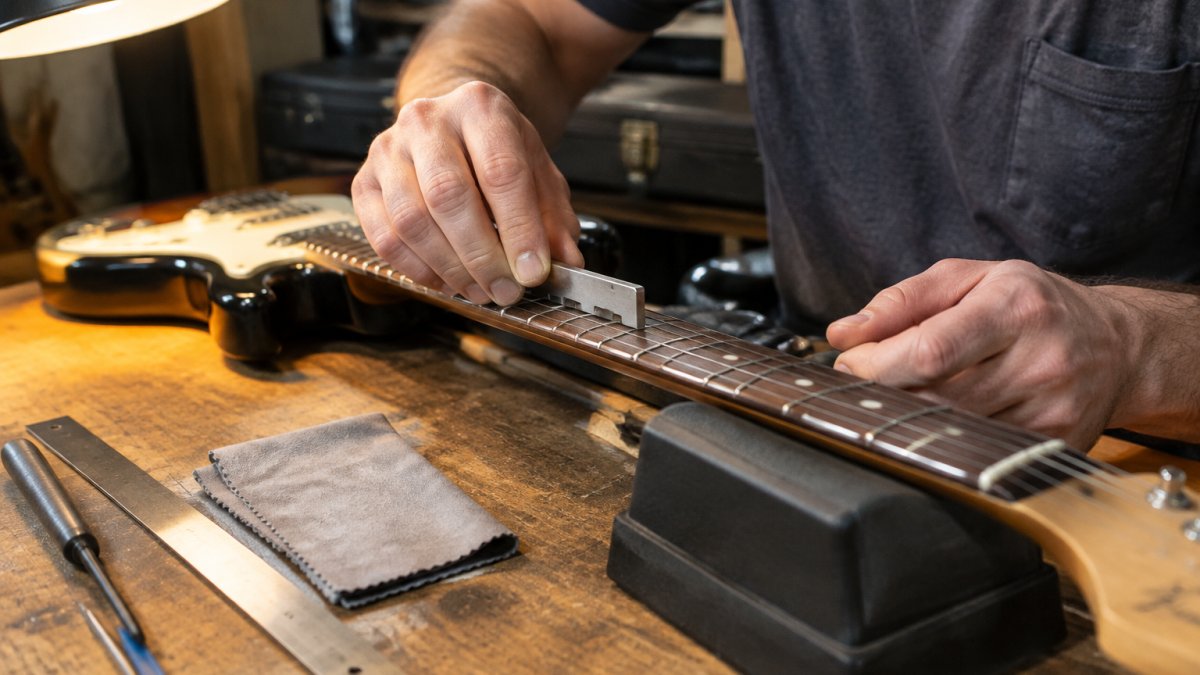
A Practical Used-Guitar Fret Inspection Checklist
Bring this list to any used-guitar viewing.
- Sight the neck from both ends for a high fret
- Rock a straightedge across three frets at several points
- Tap every fret end for a loose or unseated fret
For a deeper walkthrough, our guide on how to inspect used guitar frets before you buy covers each step in detail.
Spotting Used Guitar Fret Wear That Actually Matters
Used guitar fret wear only matters when it changes how the guitar plays or pushes it toward a repair bill. Light shine and faint marks are normal.
Start with the wear patterns. Each points to a different repair path:
- Surface shine and faint scratches: normal play wear. No repair needed beyond a polish.
- Shallow grooves under the strings: the string has started to seat into the crown. Often correctable with a fret dress if enough height remains.
- Deep grooves that catch a fingernail: the crown is significantly worn. A fret dress may still work, but only if the remaining height allows it.
Here is the distinction most buyers miss. A guitar with visible wear but level frets often plays fine and needs only a polish. A guitar that looks clean but has one high fret will fight you on every bend.
How to Judge Remaining Fret Height
The most useful measurement is how much fret is left above the fingerboard. You do not need calipers: press a string at the first fret and look at the gap to the second, then repeat at the twelfth.
Technicians typically measure fret height with a caliper or fret-height gauge and compare it to the original spec. Ask a tech to measure before you commit to a guitar with heavy wear.
Normal Wear Versus a Costly Repair
Use this sequence to decide which side of the line a used guitar sits on:
- Check level first. Rock a straightedge across three frets at several points. If frets are level, wear is mostly cosmetic and a polish may be all it needs.
- Check crown shape. Rounded crowns with shallow grooves usually respond to a fret dress. Flat tops and notches mean more material must come off.
- Check remaining height. If the crowns sit low and flat near the board, leveling will not leave enough fret to play cleanly. That is a refret.
- Check the wear pattern. Even wear across all frets is easier to dress than heavy divots in one area, which can force a partial or full refret.
- Play every position. Buzz at one or two frets points to a high spot; buzz everywhere points to setup. Choking on bends points to worn or uneven frets.
Fret material matters too. Nickel wears faster than stainless steel, so a well-used nickel-fret guitar deserves a closer look and a height measurement.
None of this is automatically a dealbreaker. It is use in the price conversation. A guitar with light, even wear and level frets is reliable fretwork with a story; one with deep divots and flat crowns is a repair estimate waiting to happen.
Guitar Fret Buzz Causes and How to Tell Them Apart
Guitar fret buzz causes fall into two groups: fret problems and setup problems. Telling them apart saves you from paying for a fret job you do not need.
Fret problems produce buzz on the same notes every time. One high fret buzzes at that fret across several strings. A loose fret buzzes with a metallic rattle.
Setup problems are broader. Too-low action, wrong neck relief, or a low nut slot buzzes across many frets or on open strings.
The quick test: fret a note at every position on one string.
Leveling, Crowning, and Polishing: What a Fret Dress Fixes
A fret dress fixes high spots, flat crowns, and rough surfaces without replacing the frets. The job has three stages, and each one matters:
- Leveling: a leveling beam with abrasive strips takes down high frets until all crowns sit even.
- Crowning: a fret file rounds each crown back to a smooth curve so notes ring clean.
- Polishing: a fret eraser and polish remove scratches, leaving frets slick under the fingers.
A fret dress is precise, patient work, and tedious, which is why techs charge for the time. Done well, it restores playability and can rescue a guitar that buzzes or chokes out. Done poorly, it flattens the crowns and shortens fret life.
This is where a good setup and fretwork overlap. Our article on why professional guitar setup matters for tone explains how fret condition and setup work together.
Guitar Refret Cost and How to Weigh It Against the Price
Guitar refret cost varies with the shop, the fret material, and whether the fingerboard needs work, but refusing to give any range leaves you unable to judge a used guitar's value. Understand the relative cost of each repair type and fold that estimate into your offer.
Relative Cost of Each Fret Repair
Think in tiers rather than exact quotes, because labor rates differ by market and shop. A common pattern is:
- Polish and setup: the lowest-cost option, for frets that are level and only need cleaning and smoothing.
- Fret dress (level, crown, polish): a mid-tier job. Real bench time, priced accordingly, but far cheaper than a refret.
- Partial refret: replacing only the most worn frets. Sometimes possible, but many shops prefer a full refret for consistency.
Stainless steel wire generally resists wear better than nickel. Ask any tech for a written quote before you buy.
Turning Fret Condition Into an Offer
Use the inspection results to place the guitar in one of four buckets, then adjust your offer accordingly:
- Light wear, level frets: no fret work needed. Buy with confidence at a normal used price.
- Worn crowns, level frets: budget for a fret dress and polish. Subtract a mid-tier repair estimate from what you would pay for a clean example.
- Deep grooves or a high fret: get a fret dress quote before you commit. If it is significant relative to the asking price, negotiate or walk.
- Frets worn to the board or flat crowns near the board: assume a full refret. On a high-priced guitar, that is usually a reason to walk away or negotiate hard.
The math is simple: compare the repair estimate to the gap between the asking price and the price of a comparable guitar with sound frets. If the discount covers the repair with room to spare, it is a reasonable buy.
Watch out: a seller's claim that the frets were "recently leveled" can mean they are now too low for another leveling. Ask for service records and have a tech measure remaining height.
Learning Fretwork Safely on a Cheap Guitar
The cheapest way to learn fretwork is on a guitar you do not care about.
Start with the low-risk jobs: polishing, then crowning, then leveling. Our guide to reliable inspected equipment for expert instrument repair covers what professionals rely on.
Watch out: a leveling beam in unpracticed hands can take a neck from playable to buzzy in minutes. Practice on scrap first.
Buying a Used Guitar With Frets You Can Trust
The honest answer to whether used guitar fretwork is reliable: usually, if you inspect it. Most used guitars leave the factory with decent fretwork and hold up for years.
At Specialty Traders, every instrument and amplifier gets a quality check and setup before it ships.
Fretwork is the one part of a used guitar you cannot fix by adjusting a truss rod, so buy from a seller who checks it for you.
Frequently Asked Questions
Can a guitar with fret buzz be fixed with a setup?
Often, yes. Fret buzz has several causes, and only some involve the frets themselves. A truss rod adjustment for neck relief, a higher action at the bridge, or a new nut can cure buzz caused by setup. If the buzz comes from one high or unseated fret, a spot level and crown fixes it. Persistent buzz in the same few spots after a proper setup usually points to uneven frets, which needs fretwork rather than another adjustment.
How much fret wear is acceptable on a used guitar?
Light, even wear across the lower frets is normal and usually harmless if notes still ring clean with no buzz. Wear becomes a problem when grooves are deep enough to create flat spots, cause notes to choke out on bends, or leave a high edge that buzzes. Check the first five frets under the plain strings, since those wear fastest. If you can feel a distinct dip with a fingernail, budget for a fret dress or refret.
How much should a guitar refret cost?
Refret pricing varies widely by region, fret material, binding, and whether the fingerboard needs work, so ask a local tech for a quote on the specific instrument. A level and crown costs far less than a full refret because it reuses the existing wire. On a used purchase, weigh the quote against the instrument's price: if the repair approaches the guitar's value, the deal rarely makes sense unless the guitar is collectible.
What is the 3 fret rule on guitar?
The three-fret rule is a quick playability check: fret a note at the third fret on each string and look at the gap between the string and the first fret. There should be a small, consistent clearance, roughly the thickness of a business card. If the string touches the first fret, the nut is cut too low; if the gap is large, the nut is too high. It is a fast way to spot nut problems that get mistaken for fret issues.
